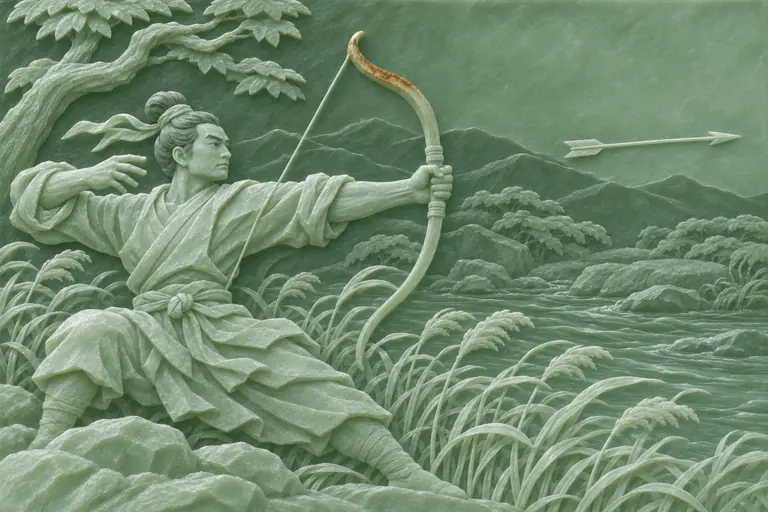
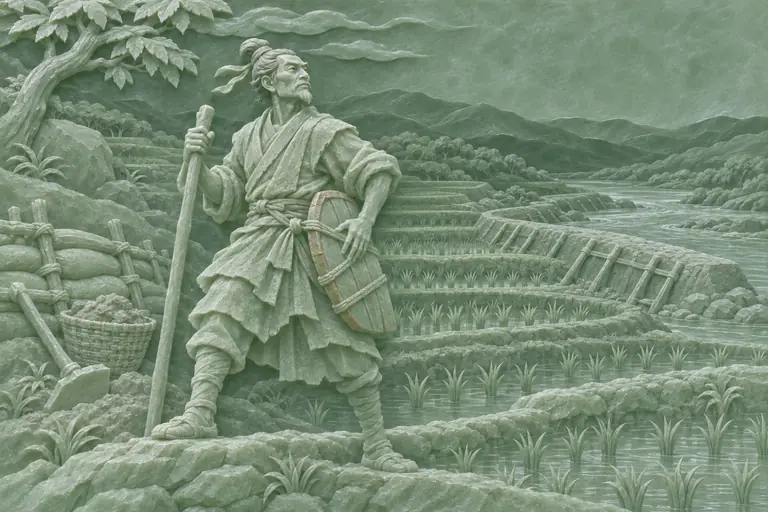
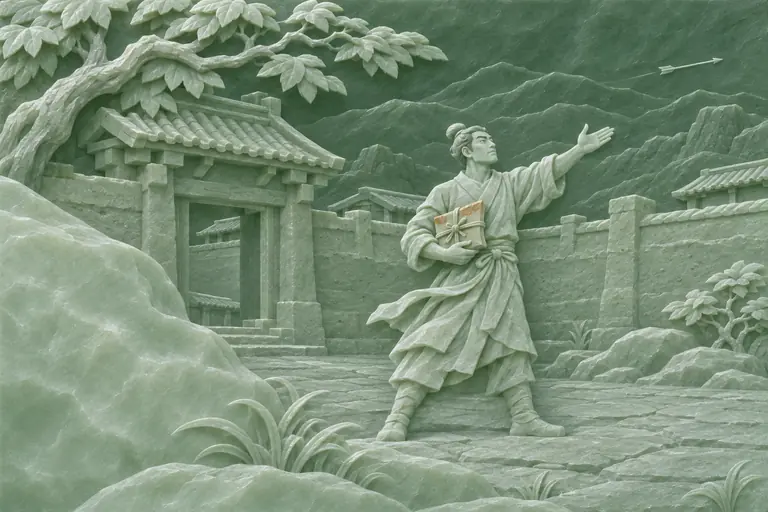
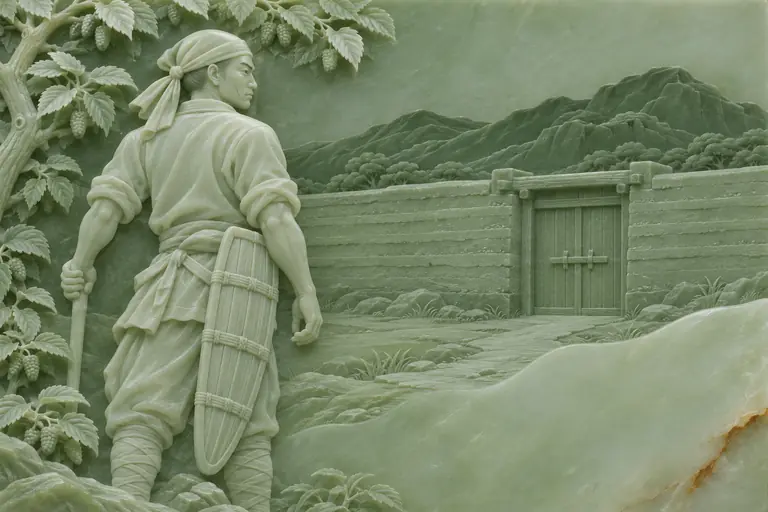
Mount Buzhou, Broken: Base art in Carved nephrite jade mountain (shanzi)Base art from card CHN-011, in Carved nephrite jade mountain (shanzi)Mount Buzhou, Broken: Base art in Carved nephrite jade mountain (shanzi)Base art from card CHN-017, in Carved nephrite jade mountain (shanzi)Base art from card CHN-011, in Carved nephrite jade mountain (shanzi)Rampaging Yayu: Base art in Carved nephrite jade mountain (shanzi)Base art from card CHN-012, in Carved nephrite jade mountain (shanzi)Base art from card CHN-012, in Carved nephrite jade mountain (shanzi)Base art from card CHN-006, in Carved nephrite jade mountain (shanzi)Base art from card CHN-011, in Carved nephrite jade mountain (shanzi)
Chinese mythology
Mending the world by hand
Early Chinese stories of making and mending the world, with some later tellings: this page covers their sources, themes, nine chapters and how the MYTH set tells them.
The set
Mountains, Seas and the Mended Sky, CHN
Base craft
Carved nephrite jade mountain (shanzi)
Cards
250
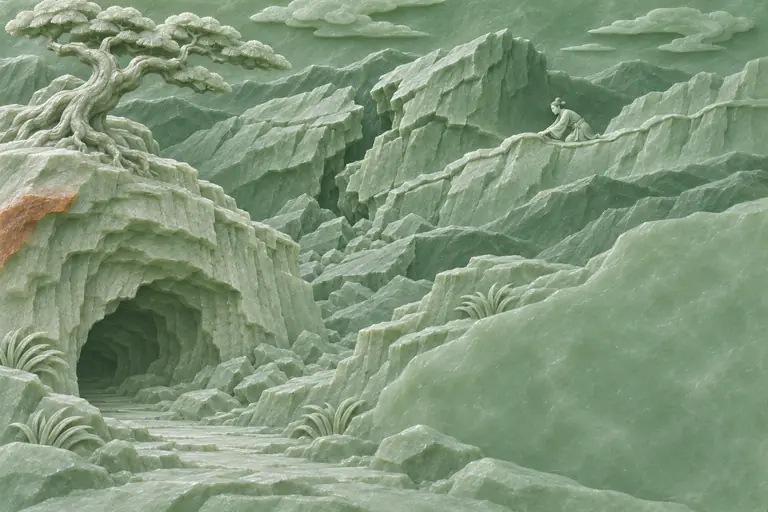
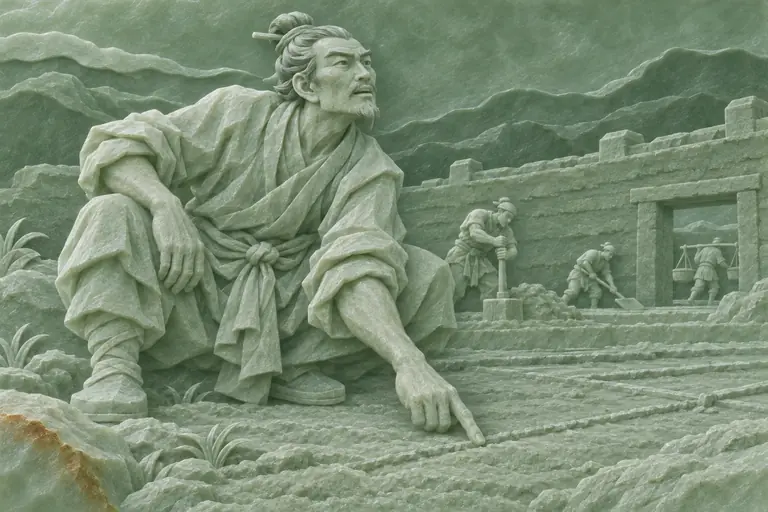
Mount Buzhou, Broken: Base art in Carved nephrite jade mountain (shanzi)
The tradition
Chinese mythology has no single book of scripture. Its oldest stories survive as fragments, quoted in works written for other purposes: a catalogue of mountains and seas, records of the early kings, philosophy, history and the songs of the southern state of Chu. Most of what survives was kept by courts and scholars, and the same event is often told in two or three versions that do not agree. Later centuries added Daoist and Buddhist tales, strange-tale collections and folk legend.
This set chooses the working stories among them. The sky cracks and has to be patched, the flood has to be led to the sea, and too many suns have to be brought down. Someone does the labour and someone bears its cost. That is an editorial choice, not a portrait of a people. Many of the figures are honoured today, at national rites and at local temples and family altars, and phrases such as Jingwei filling the sea are everyday idioms.
Carved nephrite jade mountain (shanzi)
A jade mountain is a single boulder of nephrite carved as a landscape: near ridges pale and detailed, far ones deeper green and simpler, with paths, trees and small figures between them. The form belongs to eighteenth-century Qing workshops, and the carver keeps a patch of the stone's russet skin for one detail. It is a later carver's look back, suited to stories of mountains, seas and labour.
Sources
Shanhaijing (Classic of Mountains and Seas)Warring States to HanCatalogueAn anonymous survey of mountains, seas, creatures and far lands; the source for Kuafu, Jingwei, Xingtian and Ba.
Huainanzi2nd century BCECompendiumCompiled at the court of Liu An, king of Huainan; holds Gonggong's blow, Nüwa's repair, the ten suns and the elixir.
Chu ci (Songs of Chu)Warring States to HanPoetry anthologySongs of the southern state of Chu, including the Heavenly Questions about the making of the world and the Nine Songs.
Shujing (Book of Documents)Zhou, edited in the HanCourt recordsSpeeches and records set in the reigns of Yao, Shun and Yu; some chapters are much later compositions.
ZhuangziWarring StatesPhilosophyDaoist writings that use myth to argue; the home of Hundun, emperor of the centre, and the vast bird Peng.
Sanwu lijiAttributed to the 3rd century CEChronicleA lost work credited to Xu Zheng, known only from quotation in later collections; the earliest written Pangu.
Themes
Repair by hand
Damage in these stories is mended with materials and tools, not with words. Nüwa melted stones of five colours to mend the sky, set up the legs of a great turtle as the four pillars and piled reed ash against the water. In the best-known account Yu, given his father's failed task, dug channels to lead the flood away. The set keeps the materials in view: stones, ash, mud and spades.
Some work is never finished, and the stories honour it anyway. The bird Jingwei carried twig after twig to fill the sea. Yu's diggers cut through mountains together. In the Liezi a man of nearly ninety set out with his sons and grandsons to move two mountains, and when a neighbour laughed, he answered that his descendants would carry on after him.
Gifts go wrong when there is too much of them. One sun warms the fields, and ten burn them. The self-growing soil that Gun took swelled to meet the flood and still failed. The stories treat excess as a practical problem with a practical answer: bring the extra suns down, and give the extra water somewhere to go.
Death in early Chinese myth is often a change of form rather than an ending. The drowned girl became the bird Jingwei. Kuafu's dropped staff became a forest. In one reading of an old text, Gun became a yellow bear. Later accounts say Pangu's body became the mountains, rivers and fields. The set gives several of these figures a second face, or a card for what they became.
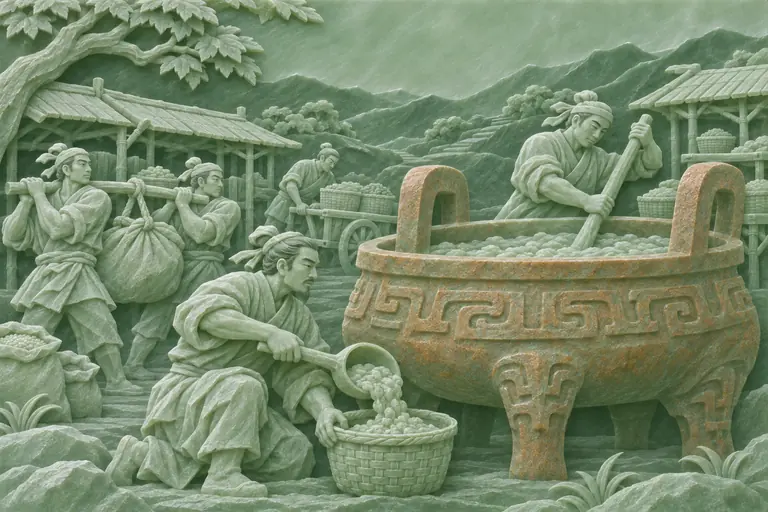
The Shanhaijing describes the world mountain by mountain: what grows and lives there, and what a sighting means. Among its marvels are a boar with a head at each end, a fox with nine tails and Zhulong, whose opened eyes make daylight. These are the book's own descriptions, not real peoples. One old account says the Xia cast cauldrons with images of such things, so travellers would know what they met.
9 stories, in reading order, each with the cards that carry it.
Pangu and the parting of heaven and earth
Chaos and the frame of the world · Xu Zheng (attributed), Sanwu liji, quoted in Yiwen leiju 1; Wuyun linian ji, quoted in Yishi 1
Base art from card CHN-011, in Carved nephrite jade mountain (shanzi)
A lost work credited to the third-century writer Xu Zheng, known from a Tang quotation, says that heaven and earth were once mixed together, like the inside of a hen's egg, and that Pangu was born within them. After eighteen thousand years they separated. What was clear and light rose to become heaven, and what was heavy and dark sank to become earth. Pangu stood between them. Each day heaven rose one zhang higher, earth grew one zhang thicker and Pangu grew one zhang taller, until heaven was very high and earth very deep. Other accounts, kept in later works, tell that when he died his body became the world: his breath the wind and clouds, his voice the thunder, his eyes the sun and moon, his blood the rivers and his flesh the fields.
The story shows a world that was not built but grown, and a body given over, piece by piece, to become the land.
In MYTH the central figure of this story appears as places, events and blessings, never as a playing piece.
Nüwa, Fuxi and Gonggong · Fengsu tongyi, quoted in Taiping yulan 78; Huainanzi, Tianwen xun and Lanming xun
Mount Buzhou, Broken: Base art in Carved nephrite jade mountain (shanzi)
A Han saying, recorded in the Fengsu tongyi, tells that when there were no people, Nüwa shaped them from yellow earth. The work was slow, so she drew a cord through the mud and flicked it, and the drops that fell became people too. The Huainanzi tells two separate stories of a damaged world. In one, Gonggong fought Zhuanxu to rule and in his anger butted Mount Buzhou, so that the sky tilted to the northwest and the land sank to the southeast, which is why the rivers run east. In the other, the four poles gave way, fires burned and floods spread. Nüwa melted stones of five colours to mend the sky, set up the legs of a great turtle, the ao, as the four pillars, and piled reed ash to stop the waters.
The story holds up repair as real work: stones melted, pillars set and ash piled, until a broken world could be lived in again.
In MYTH the central figure of this story appears as places, events and blessings, never as a playing piece.
Culture heroes and the Yellow Emperor's wars · Shanhaijing, Dahuang beijing (the storm war) and Haiwai xijing (Xingtian)
Base art from card CHN-017, in Carved nephrite jade mountain (shanzi)
When an enemy made weapons and marched against the Yellow Emperor, Huangdi sent Yinglong, a winged creature of the waters, to store up water on the plain of Ji. The enemy called on the Wind Earl and the Rain Master, who loosed a great storm. Huangdi then sent down a heavenly woman named Ba, dressed in qing, a dark blue-green, and the rain stopped. Ba could not go back up to the sky, and wherever she stayed no rain fell. Shujun reported the drought, Ba was settled beyond the Red Water, to the north, and Shujun became the ancestor of the fields. People who wanted the drought gone would clear their ditches and tell her to go north. In another fragment Xingtian fought the high god and lost his head, yet went on dancing with shield and axe.
The story shows a victory whose cost stayed behind: the woman who ended the storm could never go home.
In MYTH the central figure of this story appears as places, events and blessings, never as a playing piece.
Culture heroes and the Yellow Emperor's wars · Shanhaijing, Beishan jing (Jingwei) and Haiwai beijing (Kuafu)
Base art from card CHN-011, in Carved nephrite jade mountain (shanzi)
The youngest daughter of the Flame Emperor went to play in the Eastern Sea, drowned and did not come back. She became a bird like a crow, with a patterned head, a white beak and red feet, which cried out its own name, Jingwei. From then on she carried twigs and stones from the western hills to fill the sea that had taken her. Kuafu, a giant, raced the sun. As he came into its glare he grew thirsty, and he drank from the Yellow River and the Wei, but they were not enough. He set off north to drink from the Great Marsh and died of thirst before he reached it. The staff he dropped on the way grew into the forest of Deng. Another passage gives him a different end.
The story holds up effort that does not stop for the size of the task, and shows what such effort leaves behind.
Ten suns, the archer and the moon · Shanhaijing, Dahuang nanjing and Hainei jing; Huainanzi, Benjing xun
Rampaging Yayu: Base art in Carved nephrite jade mountain (shanzi)
The Shanhaijing says that Xihe was mother of ten suns, that they bathed in the Sweet Gulf and rested in the Fusang tree in the east, and that each sun crossed the sky carried by a crow. It also says that the high god Dijun gave Yi a red bow and white corded arrows to help the lands below. The Huainanzi tells a separate story. In the time of Yao all ten suns came out together, scorching the crops and withering the plants, and six creatures preyed on the people. Yao sent Yi, who shot at the ten suns and dealt with the six creatures one by one, killing some and capturing a great boar in the mulberry forest. A later commentary adds that nine suns fell. The people were glad, and they made Yao the Son of Heaven.
The story shows a good thing turned ruinous by excess, and the remedy left to a craftsman, done one shot at a time.
In MYTH the central figure of this story appears as places, events and blessings, never as a playing piece.
Ten suns, the archer and the moon · Huainanzi, Lanming xun and Quanyan xun; Zhang Heng, Lingxian, and Mencius 4B
Base art from card CHN-012, in Carved nephrite jade mountain (shanzi)
The Huainanzi says that Yi asked the Queen Mother of the West for the medicine of deathlessness, and that his wife Heng'e took it and fled to the moon. The astronomer Zhang Heng, writing in the Han, says that once there she became a toad. Han poems and carvings add a hare pounding medicine, and later tradition sets it in the moon. Her name is now usually written Chang'e, a change made long ago to avoid the personal name of a Han emperor. Yi's own end is told without glory, and in pieces. Mencius says that his pupil Fengmeng learned all of his archery, decided that only Yi was better than he was, and killed him. The Huainanzi says Yi died by a club of peach wood. Chang'e's flight is told every year at the Mid-Autumn Festival.
The story asks what deathlessness is worth if it must be taken alone, and leaves the famous archer to an ordinary death.
In MYTH the central figure of this story appears as places, events and blessings, never as a playing piece.
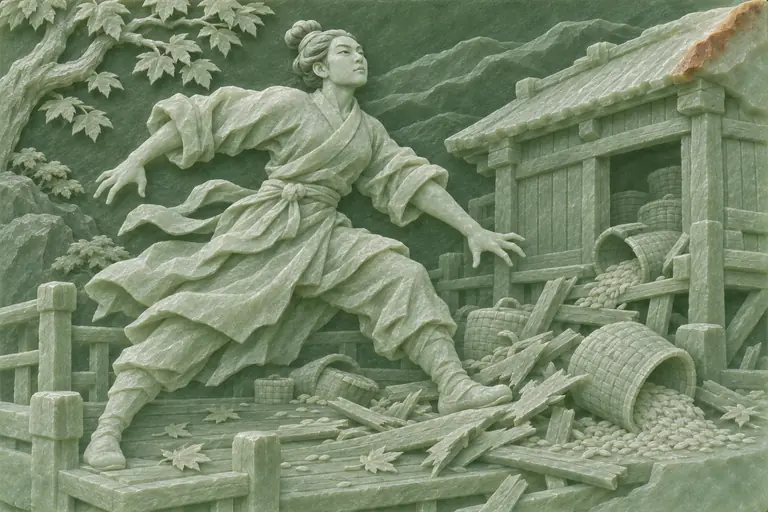
Yao and Shun · Shujing, Yaodian, Shundian and Yi Ji; Mencius 5A and Shiji 1, Wudi benji
Base art from card CHN-012, in Carved nephrite jade mountain (shanzi)
Yao, the sage king, looked for someone to follow him and passed over his own son, Danzhu, who was idle and proud and went boating where there was no water. His ministers named Shun, a commoner whose blind father, Gusou, and half-brother, Xiang, wanted him dead, yet who still treated them with care. Yao gave Shun his two daughters in marriage to see how he kept a household. In Sima Qian's telling, Shun's family sent him up to plaster a granary and set it alight, and he came down safely holding two broad hats. They sent him down a well and filled it in, and he climbed out by a side passage. In Mencius, Xiang went to take Shun's house and found Shun there, playing the zither. As ruler, Shun banished four offenders to the far borders, and when his music master played, the phoenix came to court.
The story holds up rule handed on by merit rather than birth, and a son who kept faith with a family that did not keep faith with him.
In their vast extent they embrace the hills and overtop the great heights, threatening the heavens with their floods…
In MYTH the central figure of this story appears as places, events and blessings, never as a playing piece.
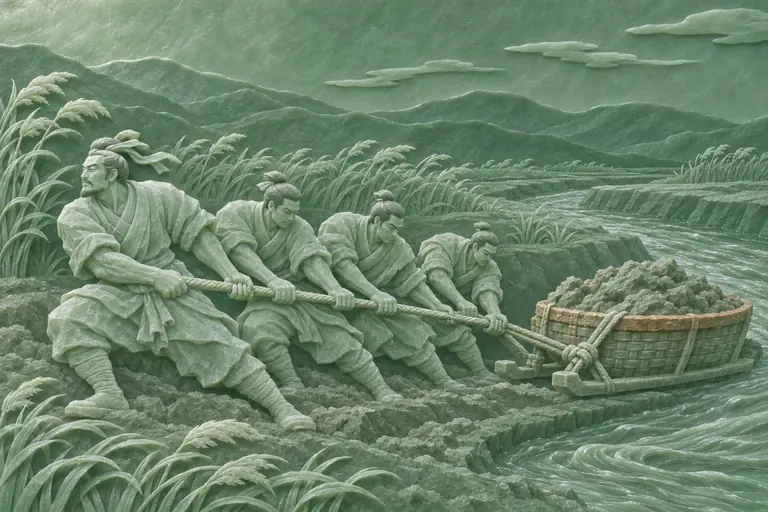
Gun, Yu and the Xia · Shujing, Yaodian and Yugong; Shanhaijing, Hainei jing, with Mencius 3A, Chu ci (Tianwen) and Zuozhuan
Base art from card CHN-006, in Carved nephrite jade mountain (shanzi)
In Yao's time the flood rose over the hills and surrounded the mountains. The tellings of what Gun did differ. In the Shanhaijing he took the self-growing soil, xirang, from the high god without leave to hold back the water. In the Shujing, Yao let him try, reluctantly. Either way the flood did not go down, and Gun was put to death at Feather Mountain. One old text, in a reading scholars still debate, says he became a yellow bear. His son Yu took up the task. In the best-known account Yu dug channels and led the water to the sea, and a commentary says Yinglong marked the courses with its tail. Mencius says Yu was away eight years and passed his own door three times without going in. When the waters went down, he divided the land into nine provinces.
The story sets two ways of meeting a disaster side by side, holding it back or giving it somewhere to go, and counts what the work cost.
In MYTH the central figure of this story appears as places, events and blessings, never as a playing piece.
Kunlun and the West · Shanhaijing, Xishan jing, Hainei xijing and Dahuang xijing; Mu Tianzi zhuan 3
Base art from card CHN-011, in Carved nephrite jade mountain (shanzi)
Kunlun stood in the far west, the high god's capital on earth. It had nine wells with jade rails and nine gates, and the Kaiming beast, large and tiger-like with nine human faces, stood guard on it facing east. Luwu, with a tiger's body, nine tails and a human face, kept the seasons of the high god's gardens. Deep waters called the Weak Water ringed the mountain. The catalogue places the Queen Mother of the West on Jade Mountain, with a leopard's tail, tiger's teeth and a piercing whistle, and three birds, green with red heads, brought her food. In the Mu Tianzi zhuan King Mu of Zhou drove west and met her as her guest. They feasted beside the Jasper Pool, where she sang to him and he answered.
The story maps the edge of the known world as a guarded mountain, reached once by a king who came as a guest.
In MYTH the central figure of this story appears as places, events and blessings, never as a playing piece.
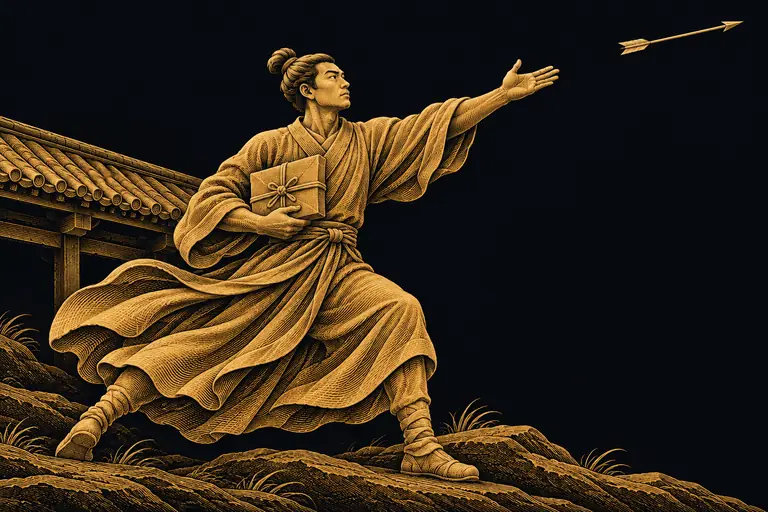
Gilded cards in this set are engravings: each is cut again in fine gold line on near-black, a new picture of the same telling, made to remember it. The gold is the house engraver's, the same in all ten sets, and belongs to no tradition.
A Gilded card is an engraving: a plate cut in gold line on near-black by someone who wanted to remember an evening's telling. All ten sets share one engraver's hand. Few exist because a plate takes a long time to cut, not because its subject is worth more than any other.
The gold belongs to the engraver, not to the story or the culture. A Gilded card never changes the rules, and the gold adds nothing to the figure it shows.
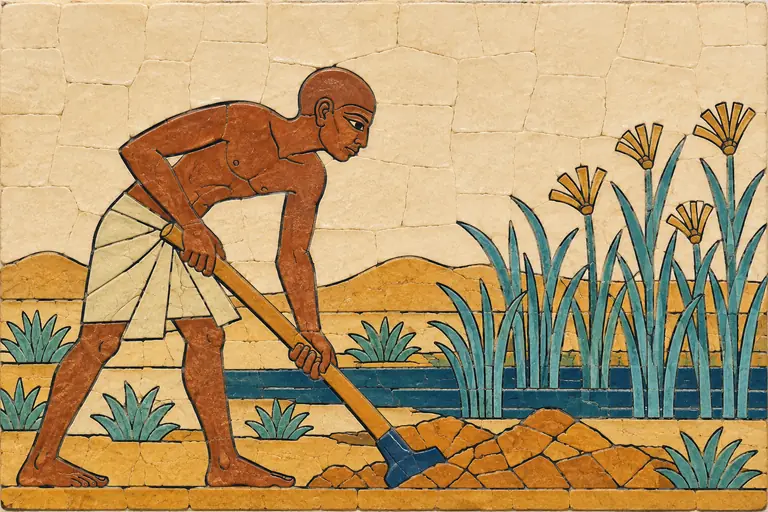
Every card has a Base face, made in its own culture's craft: lacquer and shell for Korea, red-figure for Greece, silver and niello for Ireland, grass cord for the Andes.
Herald of the Tiled Court (CHN-001), Chinese. Base in Carved nephrite jade mountain (shanzi). The current review renames it Xu You, Who Washed His Ears.
Signature cards
The cards that, more than any others, make this set Chinese.
The cauldrons of the Xia, cast with images of things so travellers knew what they met.
How the set tells it
The set gives its largest shares to the culture heroes and the Yellow Emperor's wars and to the flood, then to the ten suns and the moon and to Nüwa and Gonggong, with smaller groups for Yao and Shun, Kunlun, the Shanhaijing's creatures, the shamans of Chu and later legend. Huangdi, Yao, Shun, the Queen Mother of the West and Chang'e appear only as places, events and things. Nüwa, Pangu and Yu are currently god cards, and this page treats them, Yi and other figures with living rites as world figures. The great Ming novels are left out by choice.
The review mapped all 250 cards: 76 kept as they were, 10 given a truer scene, 115 given to a missing story, 49 proposed for a cut.
What the set still lacks
The storm war is told without its antagonist, whom some Hmong and Miao communities honour as an ancestor.
Buddhist, Daoist, household and seafaring traditions belong to Chinese mythology too, and have almost no cards yet.
The Shang and Zhou ancestor hymns, most of the Nine Songs and the western end of the sun's road are thin or missing.
The myths of China's other peoples, among them Miao, Yi, Zhuang and Tibetan, are separate traditions and are not attempted here.
Hundun1
Pangu, the egg, the body-world6
Zhulong and Zhangwei2
Heaven and earth severed; the Jianmu3
Sky lore3
Guixu, the isles, the turtles, the Longbo giant3
Lands of the dead3
Humankind made4
Fuxi and Nüwa4
Gonggong and Buzhou8
The sky mended9
Xiangliu2
Origins of fire, herbs, writing, music, silk, grain7
Shang origins3
Banquan and the storm war15
Huangdi's other stories4
Xingtian4
Jingwei, Yaoji, Kuafu7
Xihe, Changxi, Fusang, the crow, the ten suns6
Yi and his bow5
The six monsters7
Yayu's healers1
Hebo and Fufei3
Yi's death1
Elixir and moon8
Yao's court5
Shun6
Justice, music and the Four Perils6
Flood and Gun6
Yu's work13
Tushan, the bear, Qi's birth2
Monsters and giants subdued3
The realm ordered8
Xia after Yu7
Kunlun7
King Mu4
Beasts11
Omens4
Strange lands and sea-folk6
Demons of hill and water3
The catalogue's scribe1
Shamans4
Chu ci7
Zhuangzi, Liezi9
Four great folk legends5
Six Dynasties tales7
Exorcism and New Year4
Penglai, lost time, the jade3
Cards per canon element, from the set's review.
Sources and care
An outside reviewer has found living worship for many more of these figures than the set first allowed, at local temples and in family ancestor rites as well as national ones, so Nüwa, Pangu, Yu, Yi, Gonggong, Chang'e and others should appear only as places and events. The set still holds Nüwa, Pangu and Yu as god cards by the owner's decision, shown without altars or temple images, and that decision is open. The storm war's antagonist is never named. The written record was kept mostly by courts and scholars, in fragments and competing versions, so each card names the text it rests on, and outside advisers have still to review the set.
An independent expert review graded the proposed cards C: keep the set, do not lock this canon. Its corrections are being worked through before the list is locked. The retellings here leave out details the review marked for checking, though some cards listed on this page still have such details open.