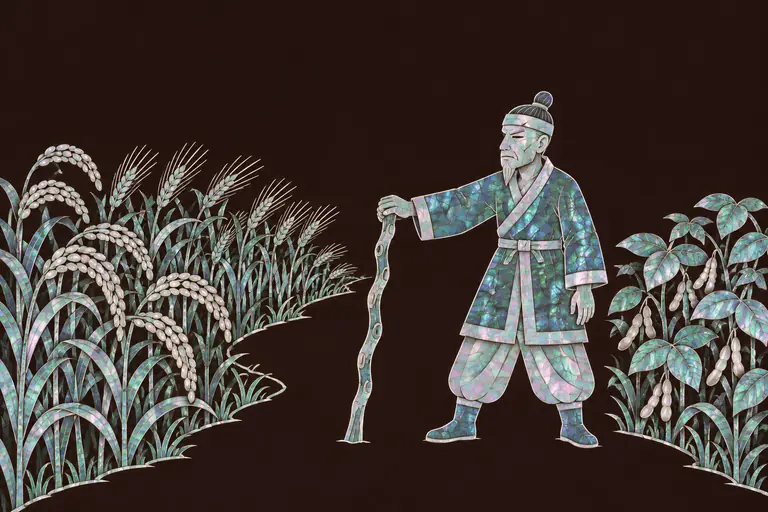
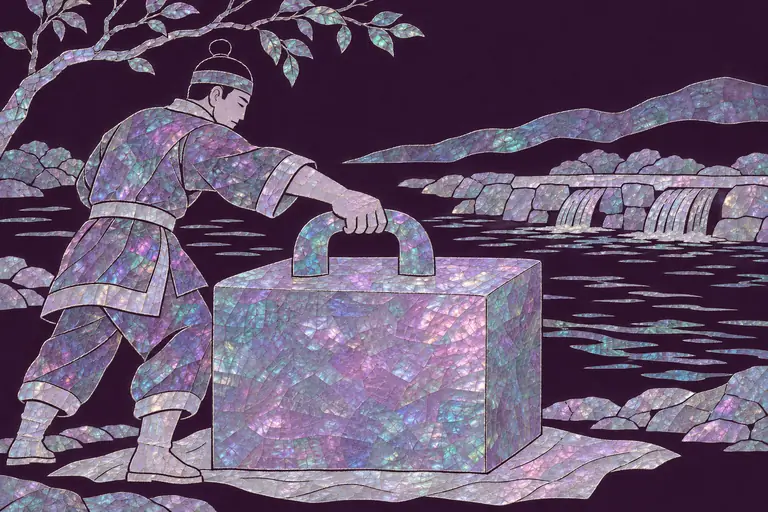
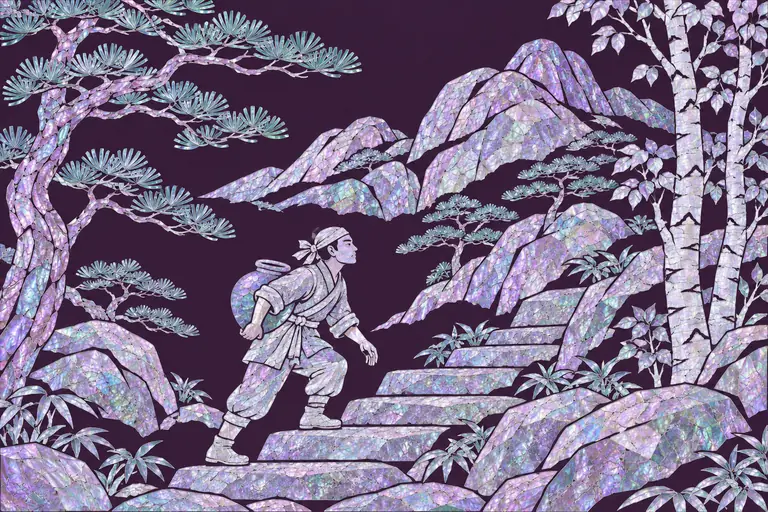
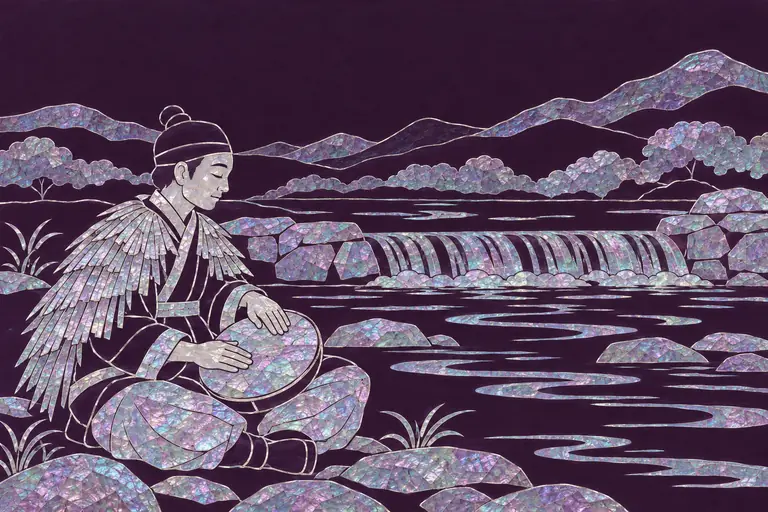
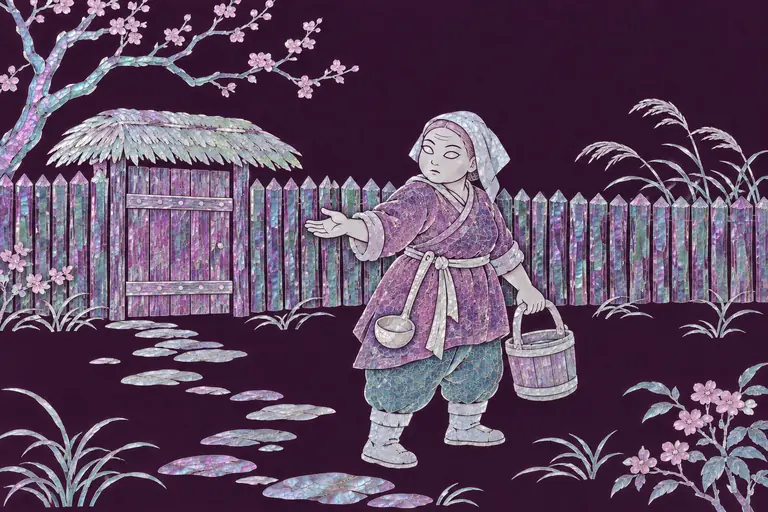
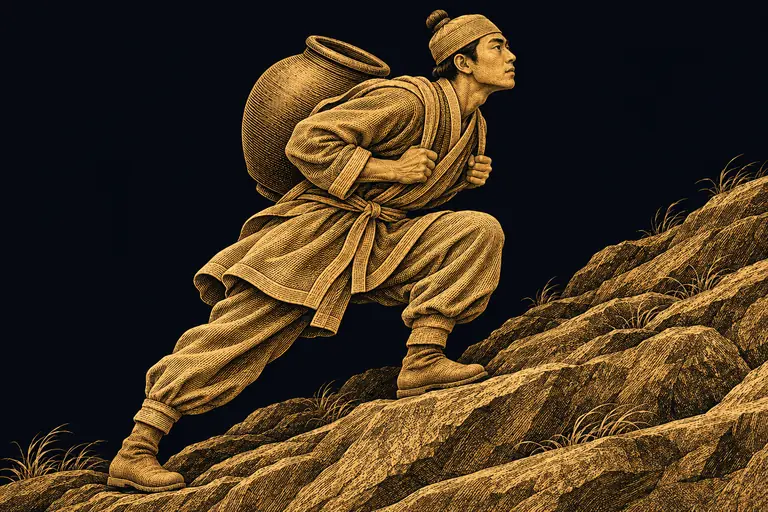
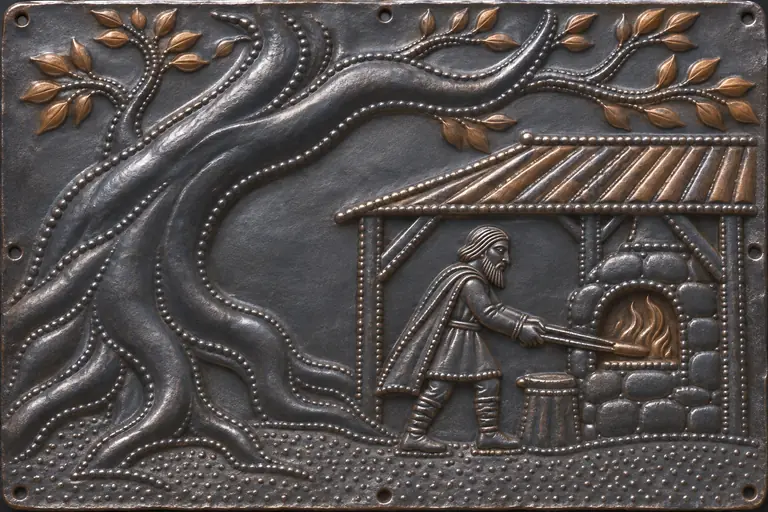
Altar Tree on Taebaek: Base art in Mother-of-pearl inlaid lacquer (najeonchilgi)Base art from card KOR-011, in Mother-of-pearl inlaid lacquer (najeonchilgi)Base art from card KOR-012, in Mother-of-pearl inlaid lacquer (najeonchilgi)Altar Tree on Taebaek: Base art in Mother-of-pearl inlaid lacquer (najeonchilgi)Prince Daeso: Base art in Mother-of-pearl inlaid lacquer (najeonchilgi)Base art from card KOR-002, in Mother-of-pearl inlaid lacquer (najeonchilgi)Base art from card KOR-012, in Mother-of-pearl inlaid lacquer (najeonchilgi)Base art from card KOR-017, in Mother-of-pearl inlaid lacquer (najeonchilgi)Altar Tree on Taebaek: Base art in Mother-of-pearl inlaid lacquer (najeonchilgi)Base art from card KOR-011, in Mother-of-pearl inlaid lacquer (najeonchilgi)
Korean mythology
Heaven's son, the bear and the egg
Korean myths tell of founders born of heaven and of eggs, a world won by a trick and tigers on the road, and this page follows their sources and stories.
The set
The Purple Stone, KOR
Base craft
Mother-of-pearl inlaid lacquer (najeonchilgi)
Cards
250
Altar Tree on Taebaek: Base art in Mother-of-pearl inlaid lacquer (najeonchilgi)
The tradition
Korean mythology comes down in layers. The founding myths of the old kingdoms were written down by Goryeo scholars in the 12th and 13th centuries, in the Samguk sagi and the Samguk yusa. Shaman songs, sung in rites by mudang on the mainland and by simbang on Jeju, were first recorded in the 20th century and are still sung. Folk tales were written down from village tellers from the 1920s on. Goguryeo tomb paintings add a world of images: a crow in the sun, guardians of the four directions.
These stories live today in rites, schoolbooks, picture books, pansori and television, and in places people still visit: a well, a peak, a pond on Jeju. Jeju Island keeps its own large body of sung myth, and the set labels it as Jeju. What holds the tradition together is less a single family of gods than a set of patterns: births from heaven and from eggs, contests won by tricks, animals that would be human, and an unfair world that someone has to live in.
Mother-of-pearl inlaid lacquer (najeonchilgi)
Najeonchilgi is lacquerwork inlaid with cut mother-of-pearl and abalone shell, set flush into a warm brown-black ground and outlined in fine twisted wire. The tradition runs from Goryeo to Joseon. Here it is a modern series design, a later craft telling older and newer stories. Flat shell shapes flash green and blue against the dark, which suits shining eggs, doubled suns and things met at night.
Sources
Samguk sagi1145ChronicleHistory of the Three Kingdoms compiled by Kim Bu-sik and colleagues for the Goryeo court, with founding tales and biographies.
Samguk yusac. 1281ChronicleCompiled by the monk Iryeon: founding myths, Silla wonders and Buddhist tales, from Dangun to Cheoyong.
Dongmyeongwang-pyeon1193PoemYi Gyu-bo's long poem on Jumong, with notes quoting an older history that does not survive.
Joseon sin-ga yupyeon1930Song collectionSon Jin-tae's book of shaman songs, including the Changse-ga sung by Kim Ssang-dori in Hamheung in 1923.
Jeju bon-puriRecorded in the 20th centuryShaman songOrigin songs of Jeju's gods, sung by simbang. Early texts came from the simbang Bak Bong-chun.
Joseon mindam-jip1930Folk tale collectionSon Jin-tae's collection of folk tales told across Korea, written down from village tellers.
Themes
Born from eggs, boxes and light
Founders in Korean myth seldom have ordinary births. Silla's first king came from a purple egg where a white horse knelt. At Guji peak in Gaya, six golden eggs came down on a purple cord. Kim Alji lay in a golden box hanging in a wood where a white rooster crowed. On Jeju, the brides of Tamna's three founders came over the sea in a chest sealed with purple clay.
Many contests are won by cheating, and the stories say so plainly. Seokga stole the flower from Mireuk's knee, and on Jeju the younger twin swapped the flower bowls. Talhae buried charcoal by a nobleman's house and claimed it as his smith ancestors' home. At Gaya he changed shape against King Suro and was bested each time. Jumong's men carried off a rival king's drum and horn and darkened them to look old.
The bear kept out of the sun and became a woman, while the tiger could not wait. In the Samguk yusa a tiger in a woman's form walked the pagoda of Heungnyun temple beside the young Kim Hyeon. The imugi, a great serpent of deep pools, may one day rise as a dragon. In a folk tale, a snail kept in a jar turned out to be a woman who cooked for a lonely farmer.
Animals remember who helped them. Heungbu bound a swallow's broken leg, and next spring it brought him a gourd seed. His gourds held rice and silk. His elder brother Nolbu broke a swallow's leg in order to mend it, and his gourds poured out trouble. Near Chiak mountain, birds whose nest a traveller had saved from a snake rang a bell before dawn to spare his life.
Households and villages keep company with gods who live close by. The kitchen god is given a bowl of fresh water each morning. After a birth, a straw rope hangs across the gate. Travellers add stones to cairns at the pass, guardian posts stand at the village mouth, and rice is set out for the messengers who come for the dead. The set shows these as places and objects, never as playing pieces.
9 stories, in reading order, each with the cards that carry it.
Mireuk, Seokga and the stolen flower
Creation · Changse-ga, sung by Kim Ssang-dori in Hamheung, 1923, in Son Jin-tae, Joseon sin-ga yupyeon (1930)
Base art from card KOR-011, in Mother-of-pearl inlaid lacquer (najeonchilgi)
The Changse-ga is a creation song sung by a shaman in Hamheung, in the far north, and recorded in 1923. Its gods carry Buddhist names. Mireuk pushed apart sky and earth, which clung together like a pot and its lid, and set copper pillars at the corners. He asked a grasshopper, then a frog, where fire and water were found, and at last a mouse showed him. He held out a gold tray and a silver tray and prayed, and insects fell onto them and grew into the first men and women. Then Seokga came and claimed the world. Mireuk won the first two contests, dangling a bottle over the sea and freezing a river in midsummer. In the third, growing a flower in their sleep, Seokga stole the bloom from Mireuk's knee. Mireuk gave up the age and left, foretelling that it would be full of cheating.
The song gives an uncomfortable answer to why the world is unfair: it was won by a trick, and people have lived with that since.
In MYTH the central figure of this story appears as places, events and blessings, never as a playing piece.
Creation (Jeju) · Cheonji-wang bon-puri, Jeju shaman song, many recorded tellings
Base art from card KOR-012, in Mother-of-pearl inlaid lacquer (najeonchilgi)
Cheonji-wang bon-puri is the creation song of Jeju Island, sung by simbang, Jeju's ritual specialists, at the opening of large rites. It tells that in the first age two suns scorched the days and two moons froze the nights. The king of heaven, Cheonji-wang, came down and fathered twin sons with a woman of the earth. When the boys were grown, they took up bows of great weight and shot down the extra sun and moon, which broke into the stars. Then the twins competed for this world by growing flowers. The younger, Sobyeol-wang, swapped the bowls while his elder brother slept, and so won the world of the living. The elder, Daebyeol-wang, went to rule the world of the dead. Because this world was won by a trick, the song says, it has thieves and wrongdoing in it.
The song holds up a plain account of why this world holds wrongdoing, and it does not hide that the winner cheated.
In MYTH the central figure of this story appears as places, events and blessings, never as a playing piece.
Altar Tree on Taebaek: Base art in Mother-of-pearl inlaid lacquer (najeonchilgi)
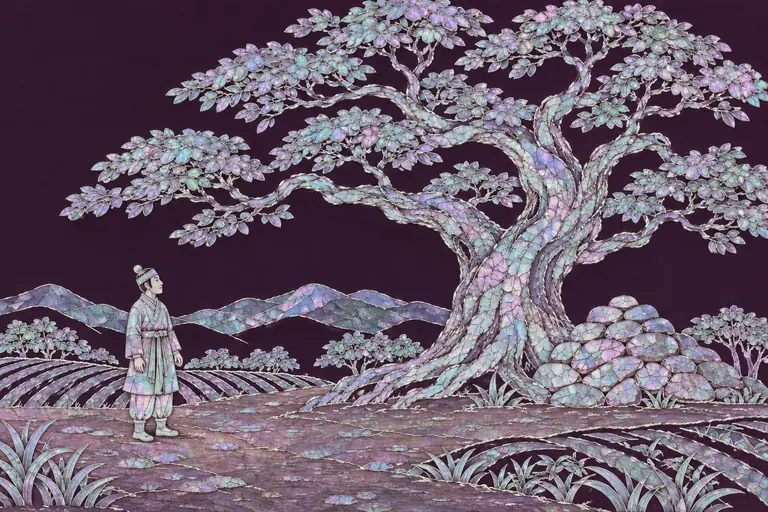
The Samguk yusa opens with Hwanung, son of the lord of heaven, who wished to live among people. His father gave him three seals of heaven, and he came down to an altar tree on Mount Taebaek with three thousand followers and the lords of wind, rain and cloud. A bear and a tiger, who shared a cave, begged him to make them human. Hwanung gave them a bundle of mugwort and twenty bulbs of garlic, and told them to keep out of the sunlight for a hundred days. The tiger could not keep the rule and stayed a tiger. The bear kept it, and on the twenty-first day she became a woman. She prayed beneath the altar tree for a child, and Hwanung took human form and married her. Their son, Dangun, founded the kingdom of Joseon and at the end withdrew to Asadal as a mountain god.
The story holds up patience and keeping a rule in the dark, and it remembers the tiger who could not, without scorn.
Founding myths · Samguk sagi, Goguryeo annals 1, and the Gwanggaeto stele (414)
Prince Daeso: Base art in Mother-of-pearl inlaid lacquer (najeonchilgi)
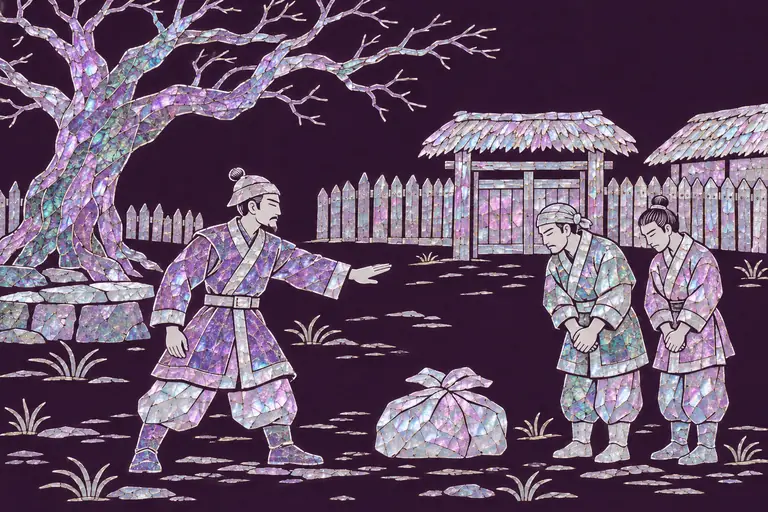
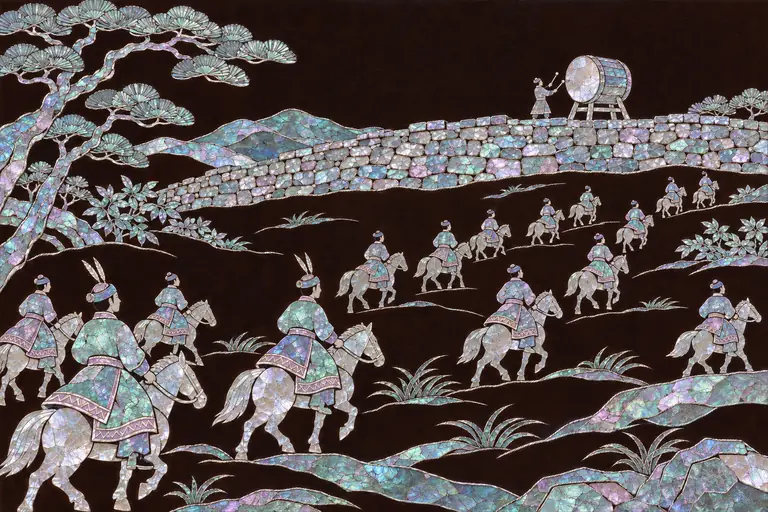
Yuhwa, whose father Habaek was earl of the river, met Haemosu, a son of heaven, and her father drove her out. King Geumwa of Eastern Buyeo found her and kept her in his palace. Sunlight followed her, and she laid an egg, from which a boy came out. At seven he made his own bow and arrows and never missed, and in Buyeo a good archer was called jumong. Geumwa's sons grew jealous. Jumong starved the swiftest horse in the stable so that the king would give it to him, and fled south with three companions. At the Eom river, with riders behind them, fish and turtles rose to make a bridge, then scattered once they were across. He founded Goguryeo at Jolbon. The Gwanggaeto stele says that at the end a yellow dragon came down and carried him up to heaven.
The story holds up a mother's care, a young archer's skill and a river that helped him, and it shows a kingdom founded in flight.
Founding myths · Samguk yusa, vol. 1, Silla sijo Hyeokgeose-wang
Base art from card KOR-002, in Mother-of-pearl inlaid lacquer (najeonchilgi)
The chiefs of six villages met above the Al stream to ask for a ruler. They saw a light like lightning touching the ground by Na-jeong well, and a white horse kneeling there. The horse cried out and rose into the sky, leaving a large purple egg, and a boy came out of it. They bathed him in the east spring, and his body shone, birds and beasts danced, and the sun and moon grew bright. They named him Hyeokgeose, bright rule, and he became Silla's first king. The same day a hen-dragon at Aryeong well bore a girl whose mouth was like a beak. Bathed in a stream, she lost the beak and became his queen. At his end his body fell to earth in five parts, and a great snake kept them from being buried together, so there are five tombs.
The story holds up a birth from light and water that a whole council saw, and a kingdom that began by asking for a ruler.
In MYTH the central figure of this story appears as places, events and blessings, never as a playing piece.
Wonders of the Samguk yusa · Samguk yusa, vol. 2, Cheoyong-rang Manghae-sa
Base art from card KOR-012, in Mother-of-pearl inlaid lacquer (najeonchilgi)
King Heongang of Silla was resting by the shore at Gaeun inlet when cloud and fog closed in and the road was lost. He was told that the dragon of the East Sea had raised it, so he ordered a temple built for the dragon, and the sky cleared. The dragon rose from the sea with seven sons, and one of them, Cheoyong, followed the king to the capital, married and took a post at court. One moonlit night Cheoyong came home and found the spirit of plague lying with his wife. He did not strike. He sang a song, danced, and stepped away. The spirit, ashamed, came out and knelt before him, and swore never to enter a house where Cheoyong's likeness was shown. So people pasted his image on their gates to keep sickness out.
The story holds up an answer to harm that is a song rather than a blow, and a face that keeps a doorway safe.
Shaman songs · Bari-gongju muga, Seoul and other regional tellings
Base art from card KOR-017, in Mother-of-pearl inlaid lacquer (najeonchilgi)
The song of Princess Bari is sung in rites that send the dead on their way, above all in Seoul and central Korea, and its tellings differ. A king and queen who longed for a son had six daughters. When a seventh was born, the king had her cast away, and her name means the thrown-away one. An old couple drew her chest from the water and raised her. Years later her parents fell gravely ill, and only water from the land in the west could cure them. Her six sisters would not go, so Bari went alone. She drew water, tended fire and cut wood for years to earn it, and married the guardian of the spring. She came home with the water and with flowers that restore bone, flesh and breath, and brought her parents back to life. Then she became the one who guides the dead.
The song holds up a daughter who went where no one else would, for parents who had cast her away.
In MYTH the central figure of this story appears as places, events and blessings, never as a playing piece.
Folk tales · Folk tale, Haenim dalnim, many oral tellings, and Son Jin-tae, Joseon mindam-jip (1930)
Altar Tree on Taebaek: Base art in Mother-of-pearl inlaid lacquer (najeonchilgi)
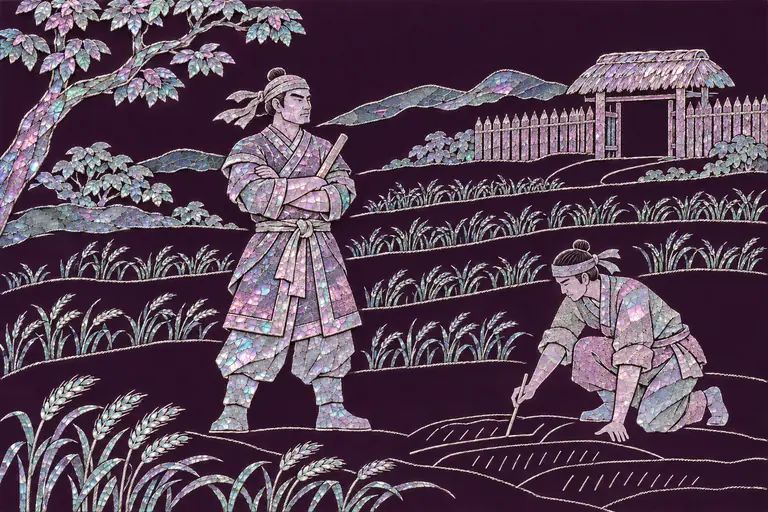
A mother went to work in a house over the mountain and told her son and daughter to open the door to no one. On her way home with rice cakes, a tiger stopped her at each pass and took a cake, and when the cakes were gone it ate her. It put on her clothes and went to the children's house, but they saw the rough paw and heard the wrong voice, and climbed a tree beside the well. The tiger could not follow until a careless word told it how. The children prayed, and heaven let down a strong rope, and they climbed it. The tiger prayed the same prayer and got a rotten one, which broke, and it fell into a sorghum field. In many tellings that is why sorghum stalks are red. The brother became the moon and the sister the sun.
The tale holds up children who kept their wits and asked for help, and it lets a tiger's greed undo itself.
Dokkaebi and ghosts · Dokkaebi tales, many oral tellings, and Son Jin-tae, Joseon mindam-jip (1930)
Base art from card KOR-011, in Mother-of-pearl inlaid lacquer (najeonchilgi)
In the tales, dokkaebi were not ghosts of the dead. Many grew from old household things, a worn broom or a long-used tool, that came alive at night. A man walking home late might be stopped by a dokkaebi who wanted to wrestle, and if he held on until dawn, he found only an old broom handle in his grip. Dokkaebi feasted, sang and drummed in empty houses, and scattered at cockcrow. A dokkaebi's club, struck on the ground, brought out whatever was named. In one tale they bought an old man's lump, thinking his songs came from it, then stuck it on the greedy neighbour who tried the same trick. A dokkaebi who borrowed a few coins might forget it had paid them back, and pay again every night.
The tales hold up good humour and fair dealing, and they let a greedy neighbour's copying go wrong.
In the Gilded edition each card is an engraving in gold line on near-black, cut to remember a telling. The gold belongs to the engraver, not to the story, and a Gilded card is the same card as its Base.
A Gilded card is an engraving: a plate cut in gold line on near-black by someone who wanted to remember an evening's telling. All ten sets share one engraver's hand. Few exist because a plate takes a long time to cut, not because its subject is worth more than any other.
The gold belongs to the engraver, not to the story or the culture. A Gilded card never changes the rules, and the gold adds nothing to the figure it shows.
Every card has a Base face, made in its own culture's craft: lacquer and shell for Korea, red-figure for Greece, silver and niello for Ireland, grass cord for the Andes.
One of the Three Thousand (KOR-001), Korean. Base in Mother-of-pearl inlaid lacquer (najeonchilgi). The current review renames it Three Thousand Who Came Down.
Signature cards
The cards that, more than any others, make this set Korean.
The three-legged crow in the sun, as painted in Goguryeo tombs.
How the set tells it
The Korean set gives its largest share, about a third of its cards, to founding myths, and keeps the Jumong cycle long because it is the fullest of them. About a fifth goes to folk tales, led by the sun and moon siblings. Wonders of the Samguk yusa, dokkaebi and ghosts, the two creation songs, the shaman songs, painted beasts and household gods share the rest. Dangun, the gods of the shaman songs and clan founders with living rites appear as places, events and blessings, not as playing pieces. By choice the set leaves out tales of revered Buddhist monks, novels such as Chunhyang, shamans' tools and modern urban legends.
The review mapped all 250 cards: 13 kept as they were, 78 given a truer scene, 154 given to a missing story, 5 proposed for a cut.
What the set still lacks
Dangun's altar and his end as a mountain god are told through a single place card.
The house lord, the birth grandmother and the Seven Stars, gods of daily household life, still need cards of their own.
The land of the dead, with its Ten Kings and its river crossing, has no place card yet.
Onjo, founder of Baekje, has no card, so Baekje is told so far through Biryu and Soseono.
Changse-ga9
Cheonji-wang bon-puri6
The giant grandmother5
Gojoseon8
The bear and the tiger9
Buyeo3
Jumong21
Yuri and the later Goguryeo tales10
Baekje and Later Baekje6
Silla8
Silla8
Gaya5
Tamna6
Goryeo ancestry4
The flute that calms the waves; the sea-dragon king4
Some figures in these stories are honoured today. Dangun has shrines, clans hold rites for founders such as Bak Hyeokgeose, King Suro and the three founders of Tamna, and mudang and Jeju simbang sing the shaman songs in living rites. The set shows all of these only as places, events and blessings, and never voices the singer or the rite. The founding myths were first written down by Goryeo scholars in the 12th and 13th centuries and are not dated history. Most shaman songs and folk tales were recorded in the 20th century, some under Japanese colonial rule. The set has had internal review only. Shaman-song specialists, Jeju simbang and communities with local rites are still to be consulted, and some figures' status is being checked.
An independent expert review graded the proposed cards C: keep the project, do not lock this list. Its corrections are being worked through before the list is locked. The retellings here leave out details the review marked for checking, though some cards listed on this page still have such details open.
No public-domain translation of this tradition's sources has yet passed the test, so its cards carry original lines and this page quotes nothing.