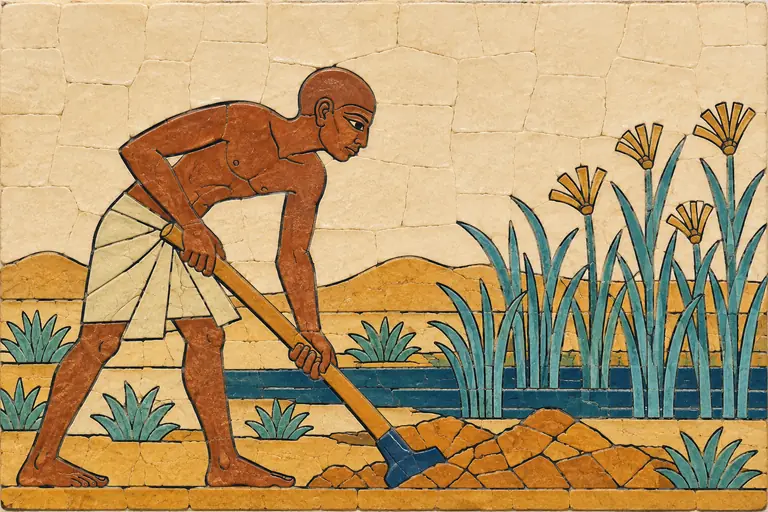
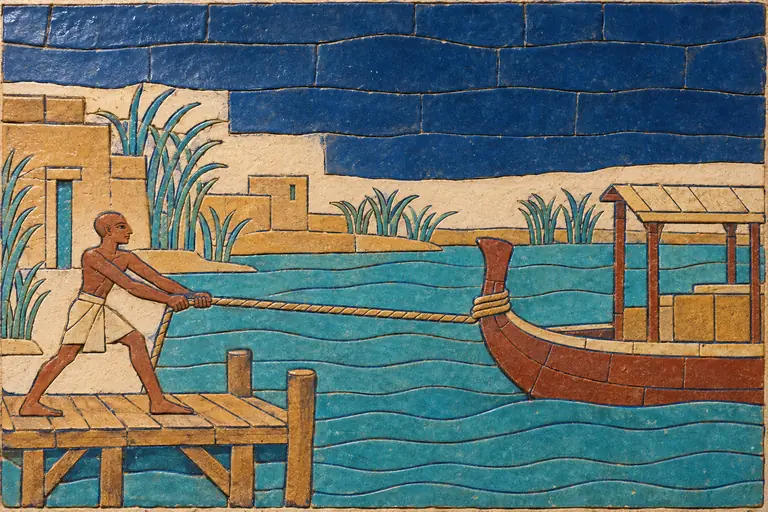
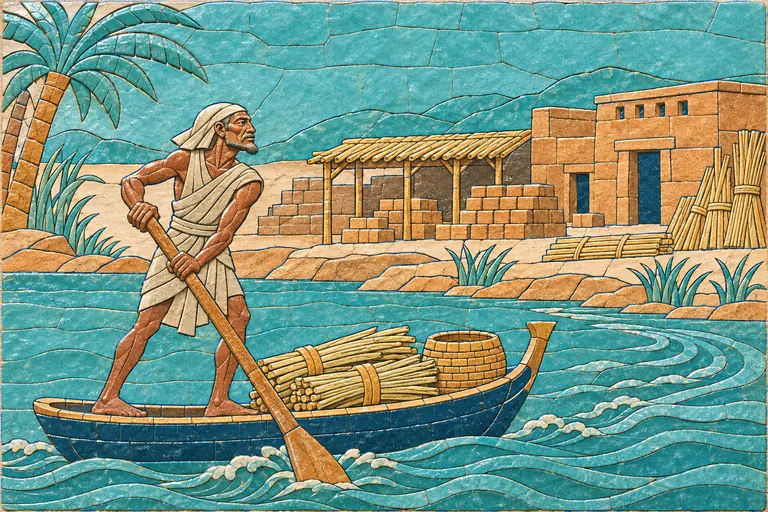
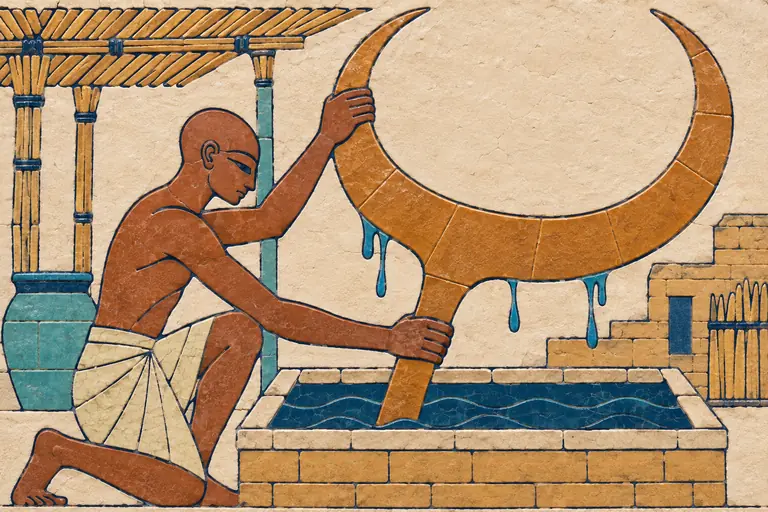
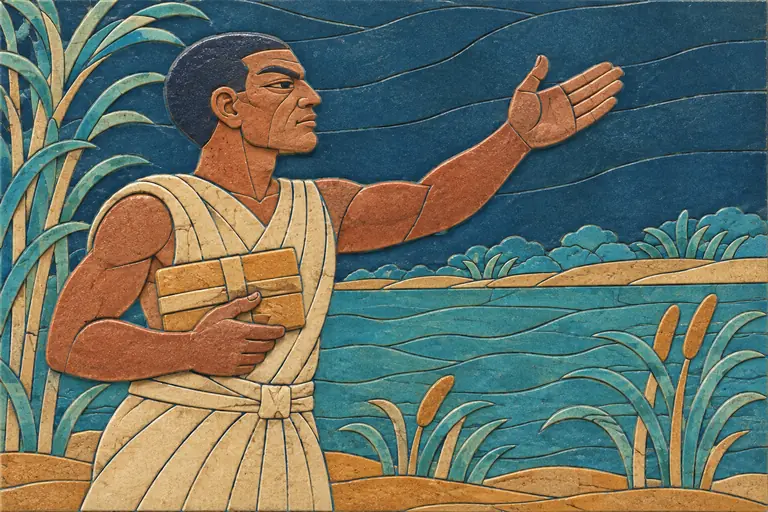
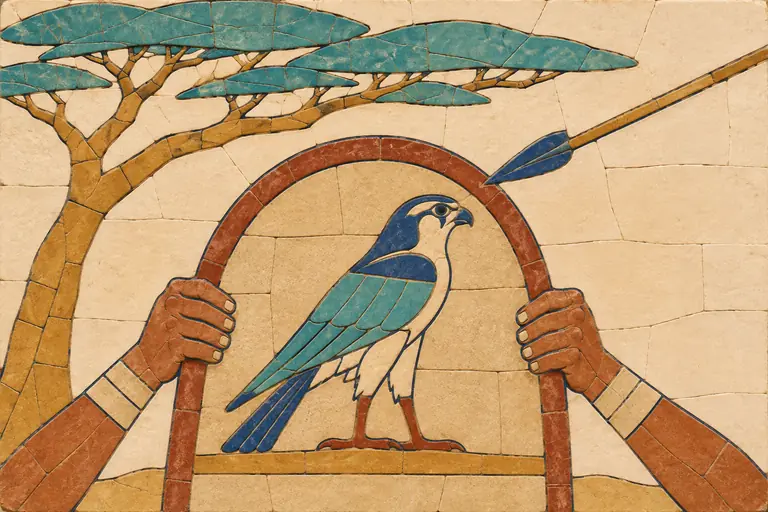
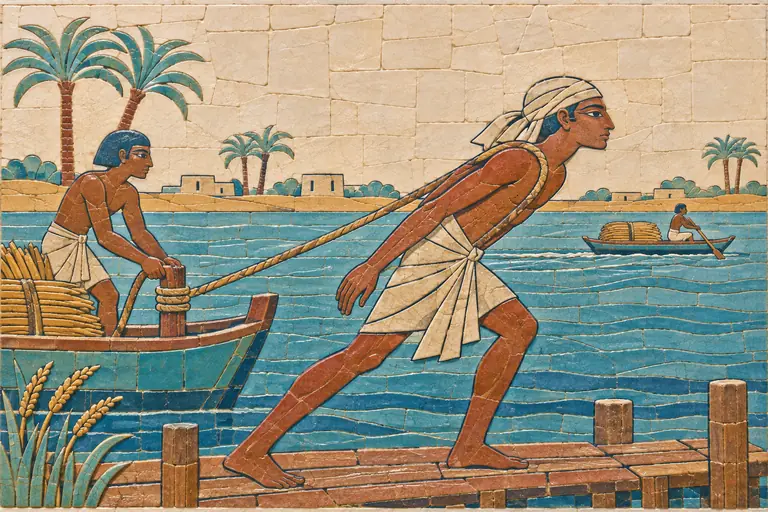
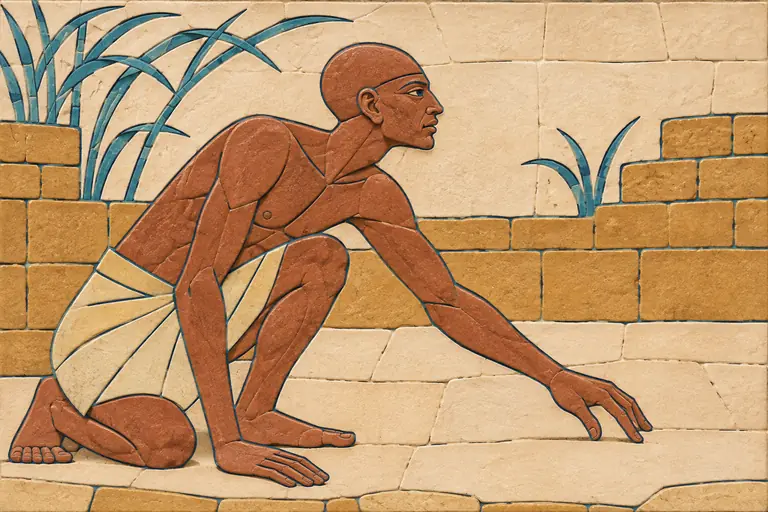
Field of Reeds: Base art in Faience tile inlay in limestone plasterSummons to the Ennead: Base art in Faience tile inlay in limestone plasterOarsman of the Day Barque: Base art in Faience tile inlay in limestone plasterBase art from card EGY-017, in Faience tile inlay in limestone plasterBase art from card EGY-003, in Faience tile inlay in limestone plasterBase art from card EGY-003, in Faience tile inlay in limestone plasterSummons to the Ennead: Base art in Faience tile inlay in limestone plasterBase art from card EGY-017, in Faience tile inlay in limestone plasterField of Reeds: Base art in Faience tile inlay in limestone plasterSummons to the Ennead: Base art in Faience tile inlay in limestone plaster
Egyptian mythology
Order kept, and renewed every day
Egyptian myth is spread across hymns, funerary books, temple walls and tales, and this page follows its creation, its sun, its gods' quarrels and the judgement of the dead.
The set
The Scale and the Hall, EGY
Base craft
Faience tile inlay in limestone plaster
Cards
250
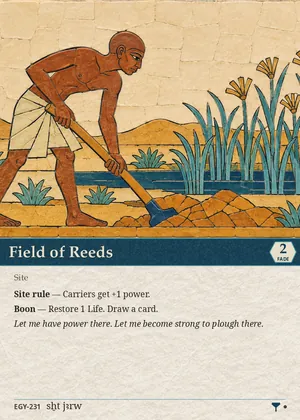
Field of Reeds: Base art in Faience tile inlay in limestone plaster
The tradition
Egyptian mythology was never written down as one book. It survives across three thousand years of texts and images: spells carved inside pyramids and painted on coffins, the Book of the Dead, the books of the sun's night hours, temple inscriptions, healing spells and a small number of literary tales. Different cities told the beginning of the world in different ways, and priests kept those accounts side by side. The fullest connected telling of the Osiris story is a Greek one, by Plutarch.
What holds it together is maat, the right order of the world, set against isfet, the disorder that always presses at its edges. Order is never won once and for all. The sun must cross the night each day past the serpent Apophis, the river must rise each year, and each person's heart is weighed after death. The stories are read today in many translations, and some of the gods are honoured in present-day Kemetic practice.
Faience tile inlay in limestone plaster
Faience is a glazed ceramic made from crushed quartz and fired to bright blues and greens. Between the 14th and 12th centuries BCE, from Amarna to the Ramesside kings, it was set as flat inlay into plaster. Each card follows that method: flat pieces of turquoise, cobalt, red-brown and sand, outlined in blue-black, set flush into pale limestone plaster. Its clear, ordered surface suits stories about order.
Sources
Pyramid TextsOld KingdomRoyal spellsSpells carved inside royal pyramids, beginning with Unas: the oldest large body of Egyptian religious writing.
Coffin TextsMiddle KingdomFunerary spellsSpells painted inside the coffins of officials, including the Book of Two Ways, an early map of the beyond.
Book of the DeadNew Kingdom onwardFunerary papyriSpells on papyrus buried with the dead, among them the weighing of the heart and the Field of Reeds.
Amduat and Book of GatesNew KingdomRoyal tomb booksPainted on royal tomb walls, they follow the sun's barque through the twelve hours of the night.
Contendings of Horus and Seth20th DynastyLiterary taleA tale on papyrus, part court comedy, about the long trial between Horus and Seth for the throne.
Plutarch, On Isis and OsirisRoman periodGreek essayA Greek writer's connected account of the Osiris story, written for Greek readers and used here with care.
Themes
Order held against disorder
Maat is the right order of things: truth, balance and justice together. Its opposite, isfet, is disorder rather than evil in a person. Each night the serpent Apophis tried to stop the sun's barque, and each night he was held off, with Seth standing at the prow to face him. Temples burned wax figures of the serpent every day, and kings were shown offering maat itself to the gods.
Nothing in this world stays done. The sun was born again each dawn, as a scarab rolling it up over the horizon. The Nile rose each summer from caverns imagined at the First Cataract and laid new soil on the fields. At the festival of Osiris, earth figures of the god were sown with grain and watered until they sprouted, and at festivals and royal jubilees a pillar was raised to set him upright.
A name was part of a person. Isis won power over Ra by learning his hidden name, and cutting a name from a wall was meant to silence its owner there. Speaking the names of the dead kept them alive. Writing belonged to Thoth, and in later tales his book, hidden in nested boxes under the river at Coptos, drew magicians who could not leave it alone.
The dead needed the living. At the tomb door a priest in a leopard skin touched the mummy's mouth and eyes to give back breath, speech and sight. The ka received the food and drink brought to the tomb, and spells hoped that the ba would come back to the body. Families spoke the offering formula, poured water and sometimes wrote letters to dead kin asking for help.
Every king ruled as Horus, the son who took his father's office after a lawful trial. In one account the earth god Geb first divided Egypt between Horus and Seth, then gave the whole of it to Horus. The double crown joined the two halves, and royal thrones showed the two rivals tying the plants of the Two Lands together, as partners.
9 stories, in reading order, each with the cards that carry it.
Atum on the first mound
Cosmogony · Pyramid Texts, Coffin Texts, Papyrus Bremner-Rhind and the Shabaka Stone
Summons to the Ennead: Base art in Faience tile inlay in limestone plaster
Before there was anything there was Nun, dark water without limit. A mound of earth rose out of it, and on the mound the creator Atum came into being by himself. Some texts tell that the Bennu bird cried out on it at the first dawn. Atum brought forth Shu, the air, and Tefnut, moisture. Texts differ on how the two and his Eye found their way back to him, but he wept, and from his tears came people. Shu and Tefnut had two children, Geb the earth and Nut the sky, and Shu lifted Nut high above Geb so that there was room for life between them. Other cities told the beginning their own way. At Hermopolis it began with eight beings of the first water. At Memphis the god Ptah made all things by thinking them in his heart and speaking them with his tongue.
The story holds up a world made by separation, with room for life opened between earth and sky.
In MYTH the central figure of this story appears as places, events and blessings, never as a playing piece.
Solar cycle · Amduat, Book of Gates, the Books of Nut and of the Night, and Coffin Texts
Oarsman of the Day Barque: Base art in Faience tile inlay in limestone plaster
By day the sun god crossed the sky in his barque. At evening the sky goddess Nut swallowed him, and he passed through the twelve hours of the night in the Duat, the world below. The serpent Mehen coiled round his cabin to shelter him. In the land of Sokar there was no water, so his crew towed the barque over sand. In the sixth hour the sun came to its own resting body, a meeting some texts read as a union with Osiris. In the seventh hour the water failed at a sandbank where the serpent Apophis lay, and magic, Isis's above all, and powers with knives bound him. Other texts tell that his gaze checked the barque and Seth stood at the prow to hold him off. At the twelfth hour the sun was born again on the eastern horizon as Khepri, the scarab.
The story shows an order that has to be won again every night, with even the strongest god needed at the prow.
…four hundred and fifty cubits in length, and he filleth it with the undulations of his body.
In MYTH the central figure of this story appears as places, events and blessings, never as a playing piece.
Eye of Ra · Book of the Heavenly Cow, from royal tombs of the New Kingdom
Base art from card EGY-017, in Faience tile inlay in limestone plaster
When Ra had grown old, people plotted against him and fled into the desert. On the advice of the gods he sent his Eye after them in the form of the goddess Hathor, and she began to strike them down. Ra then chose to spare the rest, but her anger could not simply be called off. So he sent runners to Elephantine for red ochre, had it ground into barley beer, and filled thousands of jars. In the night the beer was poured over the fields until they lay deep under it. In the morning the goddess saw her face reflected there, found it beautiful, drank, grew merry and went home without noticing the people. A yearly festival of music and drink remembered her calming. Weary of rule, Ra then left the earth on the back of Nut in the form of a cow, and the sky was made.
The story holds up mercy reached through a trick, and an anger calmed rather than defeated.
In MYTH the central figure of this story appears as places, events and blessings, never as a playing piece.
Osiris cycle · Pyramid Texts, the Great Hymn to Osiris, the Lamentations of Isis and Nephthys, and Plutarch's On Isis and Osiris
Base art from card EGY-003, in Faience tile inlay in limestone plaster
Osiris ruled Egypt as a just king. His brother Seth killed him. The Pyramid Texts tell that his sisters Isis and Nephthys found him fallen at Nedyt. They mourned him in the form of two kites, and Anubis wrapped him, whole, as the first mummy. A hymn tells how Isis searched for him without rest, sheltered him with her wings and gave him breath, raised him, and conceived their son Horus, whom she reared in secret. Osiris became ruler of the dead. Plutarch, writing in Greek under the Roman Empire, tells a different death. At a banquet Seth tricked Osiris into lying in a chest built to fit him, and threw it into the Nile. It drifted to Byblos, where a tree grew round it and was cut into a pillar of the king's palace, and Isis found it there and brought it home.
The story holds up mourning that brings life back, and a kingship that passes on even through death.
In MYTH the central figure of this story appears as places, events and blessings, never as a playing piece.
Horus and Seth · Metternich Stela and the healing stelae of Horus on the crocodiles
Base art from card EGY-003, in Faience tile inlay in limestone plaster
To keep the infant Horus safe from Seth, Isis hid him in the papyrus marshes of Chemmis. When she went out she travelled with seven scorpions as her guard. At one town a rich woman shut her door on them, and a poor marsh woman took them in. In anger one of the scorpions crept under the rich woman's door and stung her son. Isis pitied the child. She laid her hands on him and named each scorpion's poison until it left him. Later Horus himself was stung while his mother was away. Isis cried out so loudly that the sun's barque stopped in the sky, and Thoth came down with the words that cured him. Carved stones showing the child Horus standing on crocodiles carried these spells, and water poured over them was drunk as a cure.
The story ties protection from everyday dangers to a mother's care, and shows kindness answered and a closed door forgiven.
In MYTH the central figure of this story appears as places, events and blessings, never as a playing piece.
Horus and Seth · The Contendings of Horus and Seth, Papyrus Chester Beatty I
Summons to the Ennead: Base art in Faience tile inlay in limestone plaster
After Osiris died, his son Horus and his brother Seth both claimed his office, and the nine gods of the Ennead sat to judge between them. The case dragged on for eighty years. Ra favoured Seth, who defended the sun's barque every night, while others held that a son should follow his father. The court wrote to the goddess Neith, who answered that Horus should have the throne and Seth should be paid double. Isis, disguised as a young woman, told Seth of a herdsman's son robbed of his cattle, and Seth declared the robber in the wrong, so judging his own case. The rivals stayed under water as hippopotami and raced in ships of stone. Seth took Horus's eyes, and Hathor healed them with gazelle's milk. At last Seth gave way, Horus was crowned, and Seth went to live with Ra as his son, his voice the thunder.
The story holds up a lawful claim settled by a court, with the losing side honoured rather than cast out.
In MYTH the central figure of this story appears as places, events and blessings, never as a playing piece.
Magic, names and fate · Healing spell of Isis and Ra, New Kingdom papyri
Base art from card EGY-017, in Faience tile inlay in limestone plaster
Ra had many names, but one was hidden, and in it lay his power. When he had grown old, Isis gathered the spittle that fell from his mouth, mixed it with earth and shaped a serpent, which she left on the path he walked each day. It bit him, and because its venom came from his own body, none of the gods could cure it. Isis came and offered to heal him if he told her his name. He listed his titles and his forms through the day, from the scarab of morning to the old sun of evening, but the poison stayed. At last he let his name pass from his body into hers, and she drove the poison out. The story was written down as a healing spell, to be recited over someone poisoned by a bite or a sting.
The story holds up the power of a name, and the patience and cleverness that can win it.
In MYTH the central figure of this story appears as places, events and blessings, never as a playing piece.
Death, judgement and afterlife · Book of the Dead, spells 30B, 110 and 125
Field of Reeds: Base art in Faience tile inlay in limestone plaster
After death a person travelled a dangerous road, past gates kept by guardians with knives, and had to know the right names and spells to pass. At last they came to the Hall of the Two Truths. There they named each of forty-two judges in turn and denied the wrong that judge watched over: they had not stolen, had not lied, had not made anyone weep. Then Anubis set their heart on a balance against Maat's feather, while Thoth wrote down the result. A spell on a scarab laid over the heart asked it not to speak against its owner. Beside the balance waited Ammit, part crocodile, part lion and part hippopotamus, ready to eat a heart that failed. Those who passed were declared justified and led to Osiris, and lived on in the Field of Reeds, where the grain grew tall.
The story holds that a life is judged by its own heart, and that the dead could hope to be found in the right.
Let me have power there. Let me become strong to plough there.
Tales and wisdom · The Shipwrecked Sailor, Papyrus Hermitage 1115
Summons to the Ennead: Base art in Faience tile inlay in limestone plaster
An official coming home from an expedition feared how the king would receive him, so one of his followers told him a story to lift his spirits. Once, the follower said, he had sailed for the king's mines in a great ship with a hundred and twenty sailors. A storm sank it, and a wave threw him alone onto an island full of figs, grapes, fish and birds. Then he heard a noise like thunder, and a great serpent came, its scales of gold and its brows of lapis lazuli. It carried him to its home and asked how he had come there. Instead of harming him, it comforted him: it too had lost everyone, its seventy-five kin burned by a falling star. It told him a ship would come for him. The ship came, he sailed home loaded with gifts, and the island was never seen again.
The story holds up courage after loss, passed on by one who survived to someone afraid of what comes next.
A Gilded card in this set is an engraving: the same card cut again in gold line on near-black by an engraver who wanted to remember a telling. The gold is the engraver's material, the same in all ten sets.
A Gilded card is an engraving: a plate cut in gold line on near-black by someone who wanted to remember an evening's telling. All ten sets share one engraver's hand. Few exist because a plate takes a long time to cut, not because its subject is worth more than any other.
The gold belongs to the engraver, not to the story or the culture. A Gilded card never changes the rules, and the gold adds nothing to the figure it shows.
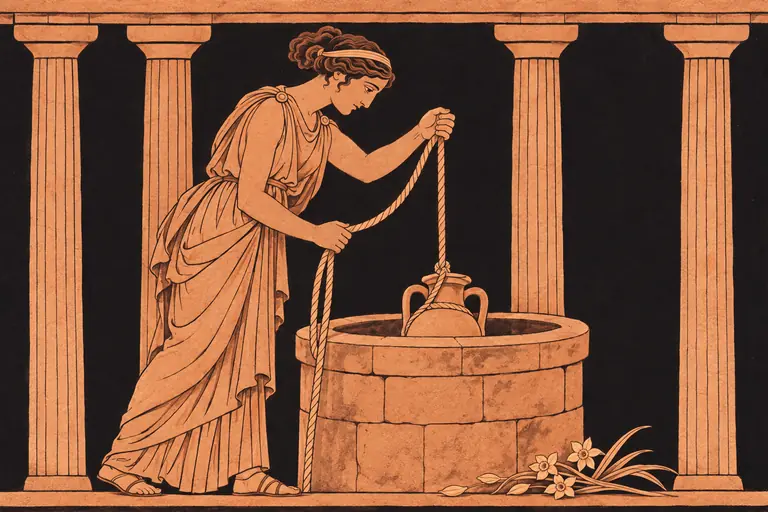
Every card has a Base face, made in its own culture's craft: lacquer and shell for Korea, red-figure for Greece, silver and niello for Ireland, grass cord for the Andes.
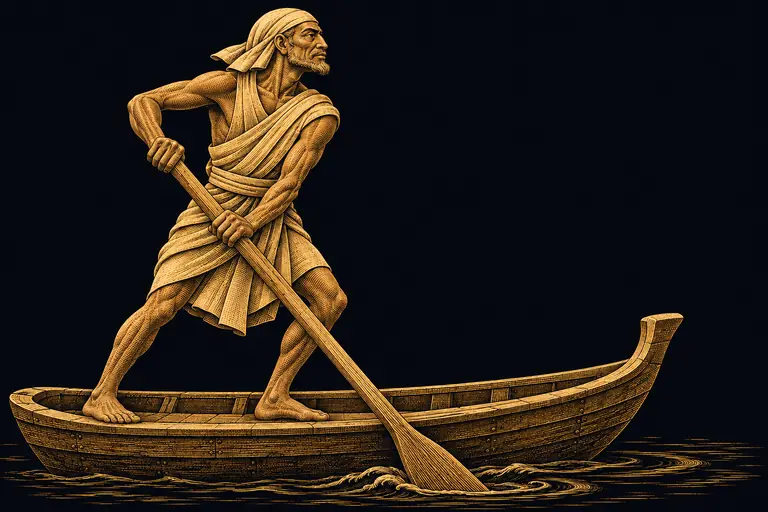
Oarsman of the Day Barque (EGY-001), Egyptian. Base in Faience tile inlay in limestone plaster.
Signature cards
The cards that, more than any others, make this set Egyptian.
Where the justified hoped to live and farm after death.
How the set tells it
The set gives its largest shares to the judgement of the dead and to Horus and Seth, about forty cards each, then to the sun's daily round, the Osiris story and the literary tales, which supply most of its mortal heroes. The draft gave five gods, Osiris, Isis, Horus, Seth and Thoth, cards of their own. On review advice this page treats them like Ra, Anubis, Hathor and every other deity, as places, events and things made, never as playing pieces. Seth is a lawful rival, never a villain, and Osiris is always shown whole.
The review mapped all 250 cards: 5 kept as they were, 101 given a truer scene, 132 given to a missing story, 12 proposed for a cut.
What the set still lacks
Anubis and Hathor appear only inside other scenes, with little room for their own distinct roles.
Amun has a single card. The Opet procession and Karnak are missing.
Many places are absent, among them Giza, Philae, Dendera, Karnak and Sais.
The moon god Khonsu and the fate of the damned are barely present.
Nun, the first mound, the Bennu2
Atum, Shu and Tefnut; Geb and Nut parted2
Hermopolis4
Memphis2
Khnum and the potter's wheel2
Maat; mankind from the creator's tears3
The five days over the year1
Day barque, three forms of the sun, Nut5
Night barque and its crews; the dead of the hours6
Land of Sokar2
Sixth hour2
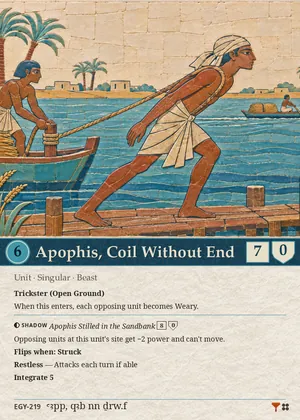
Apophis and his defeat10
Book of Gates1
Dawn4
Star-lore2
Mankind's plot; the Eye sent2
The red beer and its festival6
Ra withdraws on the Cow of Heaven2
The Distant Goddess and her return2
Uraeus; Sekhmet's messengers2
Reign and death of Osiris5
Isis at Byblos4
Gathering, embalming, awakening5
The two kites4
Abydos mysteries, djed, pilgrimage6
Osiris as lord of the West and of grain2
Chemmis8
The tribunal of the Ennead9
Isis's ruses at the Island in the Midst3
The contests3
The Eye of Horus wounded and made whole3
Verdict, crowning, the Two Lands united8
Edfu8
Funeral8
Journey of the dead8
Weighing of the heart10
Life of the justified6
Ba, ka, akh3
Cult of the dead8
Isis and the secret name of Ra5
Healing magic5
Writing, names and their erasure4
Fate and birth protection2
Kingship8
Djoser and the seven lean years3
The flood, Black Land and Red Land10
Wonders at Khufu's court7
Sinuhe3
Shipwrecked Sailor2
Eloquent Peasant2
Two Brothers4
Doomed Prince5
Setne and the Book of Thoth7
Dispute with the ba, Harper's Song, Truth and Falsehood3
Sacred and fabulous animals7
Cards per canon element, from the set's review.
Sources and care
Egyptian myth comes to us across three thousand years of texts made for temples, tombs and kings, and many stories survive only in pieces. The fullest Osiris narrative is Plutarch's, written in Greek under the Roman Empire, and cards that rest on it say so. Older English translations carry their translators' views, so the set never uses their commentary. Some of these gods are honoured in present-day Kemetic practice. An independent review advises that the five gods drafted as playing pieces become places and events like every other deity, since hiding a god's face or name on a playing piece changes nothing. Seth is never shown as evil, and Osiris is never shown broken. Outside advisers have still to read the set.
An independent expert review graded the proposed cards B: for selection; not ready to lock. Its corrections are being worked through before the list is locked. The retellings here leave out details the review marked for checking, though some cards listed on this page still have such details open.
Lines the cards quote
Every quotation on this page and its cards comes from a public-domain translation, checked against the source text.
The oars are lifted into the sektet boat, and the sacred boat cometh in peace.
…her heart rejoiced, and she became drunk, and she gave no further attention to men and women.