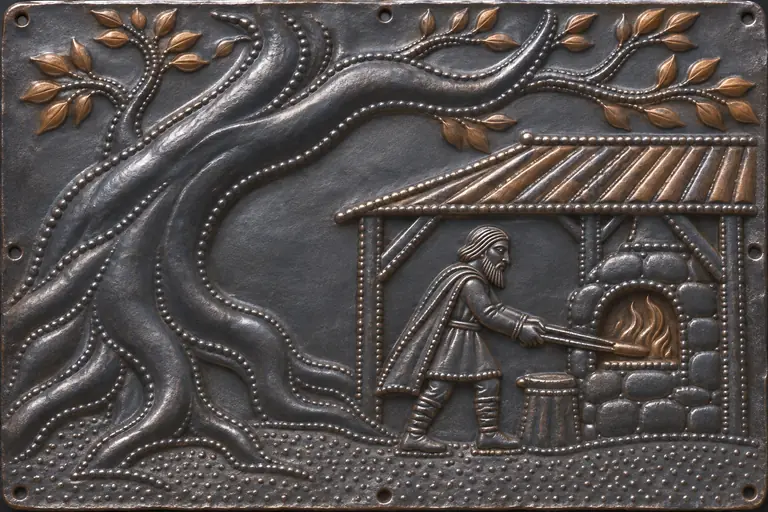
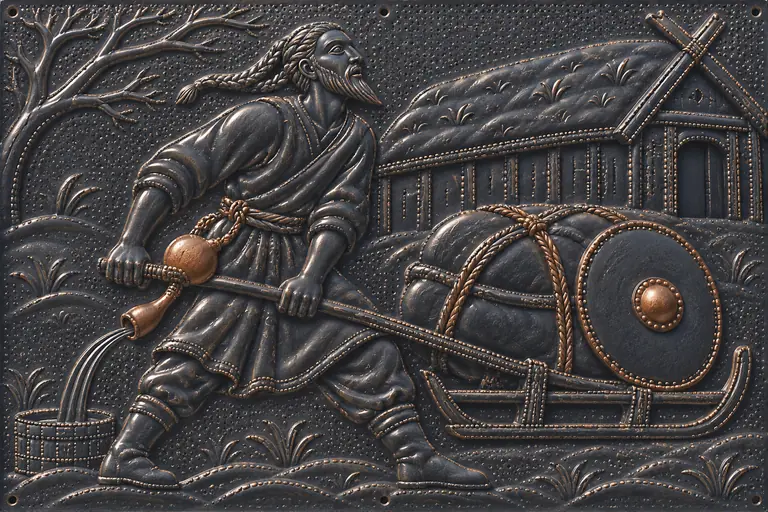
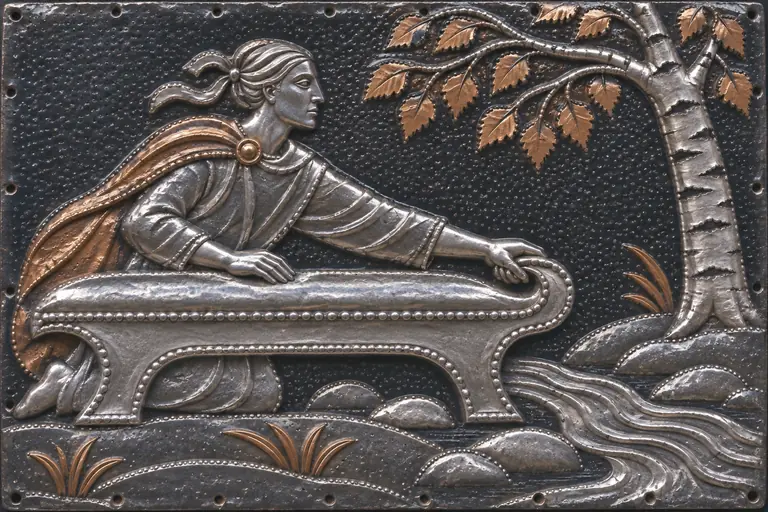
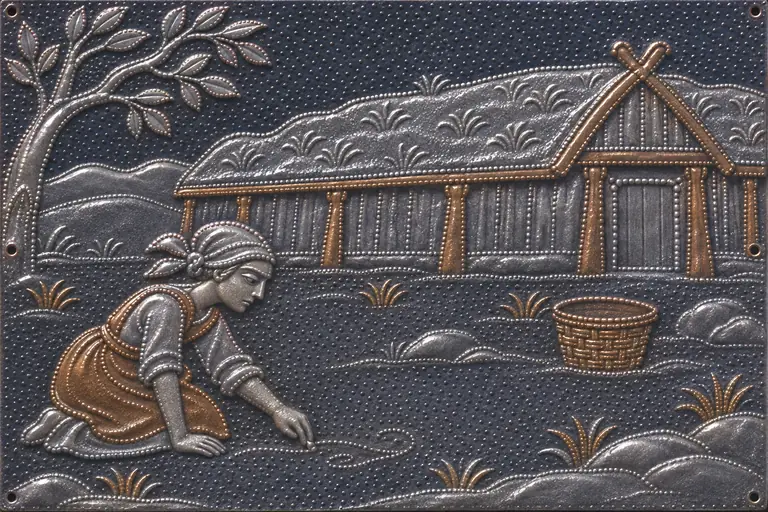
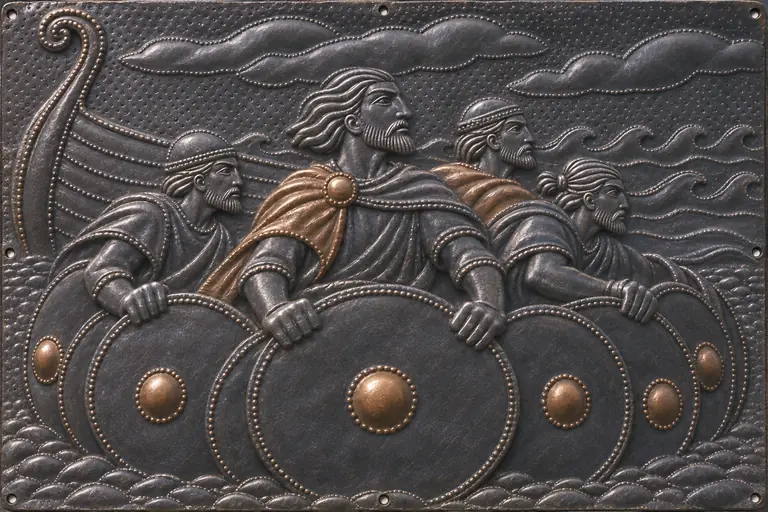
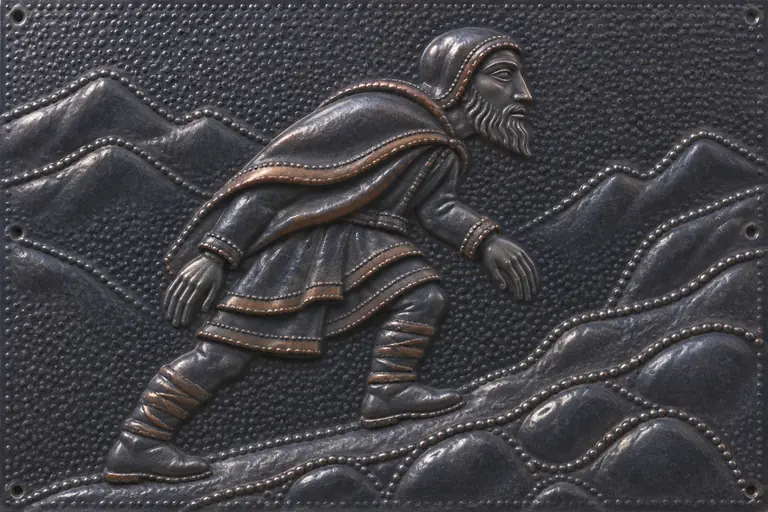
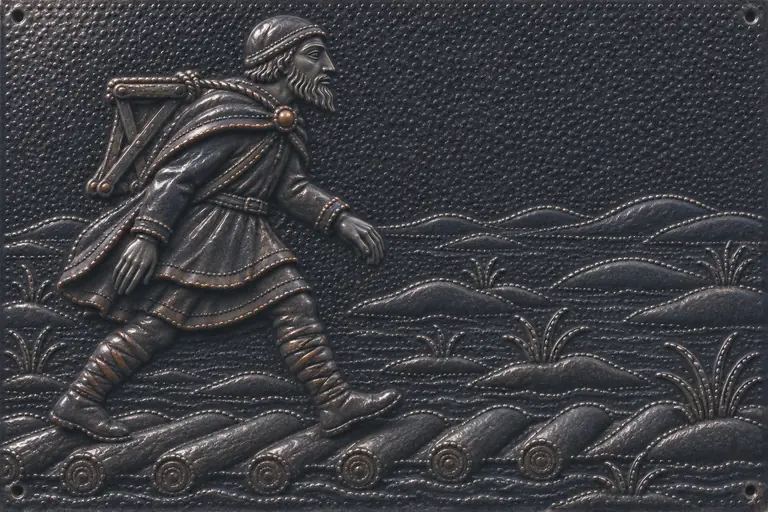
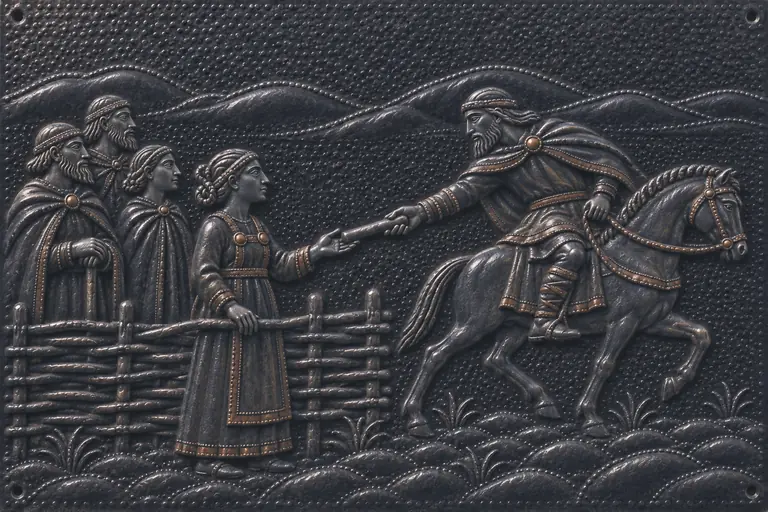
Base art from card NOR-231, in Stamped foil plaques (Vendel-period pressblech)Base art from card NOR-002, in Stamped foil plaques (Vendel-period pressblech)Base art from card NOR-231, in Stamped foil plaques (Vendel-period pressblech)Base art from card NOR-017, in Stamped foil plaques (Vendel-period pressblech)Base art from card NOR-003, in Stamped foil plaques (Vendel-period pressblech)Base art from card NOR-001, in Stamped foil plaques (Vendel-period pressblech)Base art from card NOR-012, in Stamped foil plaques (Vendel-period pressblech)Base art from card NOR-122, in Stamped foil plaques (Vendel-period pressblech)Base art from card NOR-017, in Stamped foil plaques (Vendel-period pressblech)Base art from card NOR-012, in Stamped foil plaques (Vendel-period pressblech)
Norse mythology
An end foretold, and met anyway
This page follows the myths of pre-Christian Scandinavia as Iceland wrote them down, from a world made out of a giant to the end the gods saw coming.
The set
Knowable Doom, NOR
Base craft
Stamped foil plaques (Vendel-period pressblech)
Cards
250
Base art from card NOR-231, in Stamped foil plaques (Vendel-period pressblech)
The tradition
Norse mythology is the body of stories about the gods, giants and heroes of pre-Christian Scandinavia. Most of it survives in Icelandic manuscripts of the 13th century: the Poetic Edda, a collection of anonymous poems, and the Prose Edda of Snorri Sturluson, a handbook for poets. Older court poetry, picture stones and carvings from Gotland, Sweden, Norway and northern England show that many of its scenes were told and pictured long before anyone wrote them down.
One arc holds the stories together. The world is made from the body of the first giant, ordered by the gods and held together by an ash tree. The gods gain knowledge and safety, often at a cost to themselves, and a seeress tells them how it will end. They go out to meet that end anyway, and after the fire the earth comes up green from the sea. The stories are widely read and retold today, and some of the gods are honoured in present-day Heathen practice.
Stamped foil plaques (Vendel-period pressblech)
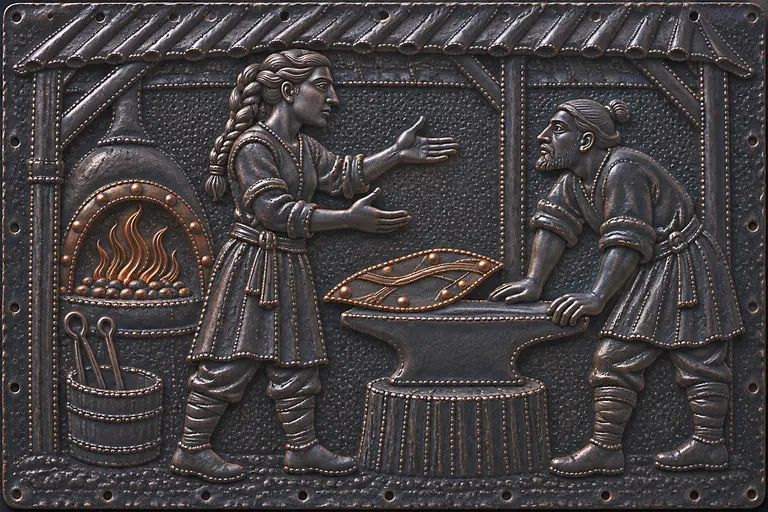
Pressblech is thin sheet-metal foil stamped over a die, so that figures rise from it no deeper than a coin. Smiths in Sweden worked this way in the 6th to 8th centuries, as finds from Torslunda and Valsgärde show. Each card follows them: figures in profile, beaded outlines, a punched-dot ground of blue-black iron, touches of copper-bronze. The craft is older than the manuscripts that keep these stories.
Sources
Poetic Edda (Codex Regius)c. 1270Manuscript of poemsAnonymous poems on gods and heroes copied in Iceland, among them Völuspá, Hávamál and the lays of Sigurðr.
Prose Eddac. 1220Handbook for poetsSnorri Sturluson, Icelandic chieftain and poet, retells the myths in connected prose so that poets could understand the old verse.
Skaldic poetryViking AgeCourt poetryPoems older than both Eddas, such as Haustlöng and Húsdrápa, describing mythic scenes on a painted shield and carved hall panels.
Picture stones and carvingsViking AgeImagesStones at Altuna, Gosforth and Ramsund and on Gotland show Thor's fishing, Sigurðr and the dragon, and other scenes.
Völsunga saga13th centurySagaAn Icelandic prose retelling of the Völsung heroes, making its own choices, and a witness where Codex Regius leaves are lost.
Themes
An end known in advance
The seeress who speaks in Völuspá tells Odin how the world began and how it will end: years of winter, kin turning on kin, the wolf loose, the sun swallowed, a horn blown. Again and again she asks whether he wishes to know more. Nothing changes the outcome. The gods go out to meet it, and the poem turns to a green earth, though its last lines bring back the dragon.
Odin sought knowledge and gave something of himself for it. In Hávamál he tells of hanging nine nights on a tree before he could take up the runes. Völuspá says that his eye lies as a pledge in Mímir's well, and Snorri adds that it was given for a drink. Ynglinga saga tells that he kept Mímir's head with herbs and spells, and Völuspá has him take counsel from it.
Oaths hold this world together, and they keep failing. The gods swore to a giant builder and broke their word when he nearly finished their wall. Frigg took oaths from everything in the world not to harm Baldr, and passed over the mistletoe. Týr's hand was the pledge that the wolf's binding was fair, and it was not. Brynhildr, won by deception, held to her own vow, and it cost Sigurðr his life.
The dwarves are the great makers. When Loki cut off Sif's hair, the sons of Ívaldi made her new hair of gold that grew, along with a ship that folds away and a spear. Loki then bet his head that Brokkr and his brother could do no better. When a fly made Brokkr falter at the bellows, Thor's hammer came out short in the handle, yet the gods judged it the best gift of all.
Hávamál sets out what a traveller needs on arrival: warmth, water, a towel and a welcome. In the hall of Útgarða-Loki, Thor lost every contest he was set, and learned next morning that he had drunk from the sea, wrestled old age itself and tried to lift the world serpent as a cat. At the sea-giant Ægir's feast, Loki traded insults with every god present until Thor's threats drove him out.
9 stories, in reading order, each with the cards that carry it.
Ymir and the making of the world
Cosmogony and the tree · Völuspá, Vafþrúðnismál, Grímnismál and Snorri's Gylfaginning
Base art from card NOR-002, in Stamped foil plaques (Vendel-period pressblech)
Before anything was made there was Ginnungagap, an emptiness with no grass anywhere. Frost lay on one side of it in Niflheimr and fire on the other in Múspell, and where the rime met the heat it quickened into Ymir, the first giant. The cow Auðumbla fed him with her milk, and licking the salty ice she freed Búri, grandfather of Odin. Odin and his brothers killed Ymir, and his blood drowned all the frost-giants except Bergelmir and his wife. From his body they made the world: earth from his flesh, sea from his blood, sky from his skull, with a dwarf set under each corner. Snorri tells that on the shore they found two trees and gave them breath and life, and these were the first people, Ask and Embla. Then the gods met on the plain of Iðavöllr, built forges and played board games in the grass.
The story holds up a world built out of what came before it, shaped and shared out, with the giants' kin always at its edge.
Cosmogony and the tree · Völuspá, Grímnismál and Snorri's Gylfaginning
Base art from card NOR-231, in Stamped foil plaques (Vendel-period pressblech)
The worlds were held together by an ash, Yggdrasil, the greatest of all trees. In Snorri's account one root reached to the gods, one to the frost-giants and one to Niflheimr, and beneath them lay wells. The gods rode over the bridge Bifröst to hold their court at Urðr's well, all but Thor, who waded through rivers. Mímir's well held wisdom. In Hvergelmir, the seething spring from which every river ran, the dragon Níðhöggr gnawed at the root. An eagle sat in the crown, harts bit at the leaves, and the squirrel Ratatoskr ran up and down the trunk carrying spiteful words between eagle and dragon. Three norns drew water from their well and poured it over the tree so that it would not wither. They cut marks in wood, laid down laws and chose the lives of people.
The story shows a living world under strain from every side, kept standing by daily care.
Three roots sustain the tree and stand wide apart…
The first war and the wall · Völuspá, Snorri's Gylfaginning and Skáldskaparmál, and Ynglinga saga
Base art from card NOR-017, in Stamped foil plaques (Vendel-period pressblech)
Völuspá calls it the first war. The Æsir pierced Gullveig with spears and burned her three times in their hall, and three times she lived. Odin threw his spear over the Vanir host, and the two families of gods fought until the Æsir's wall was broken. Snorri tells that they made peace by spitting into one vat, and from the spittle made the wise Kvasir. Ynglinga saga instead makes Kvasir one of the hostages they exchanged. Later, in Snorri's telling, a builder offered to raise a new wall round Ásgard in three seasons, for Freyja, the sun and the moon. The gods held him to one winter with no man's help, and on Loki's advice let him use his stallion Svaðilfari. Three days before summer only the gate remained. A mare lured the stallion away, the builder raged, and Thor killed him. Völuspá remembers the oaths that were broken.
The story asks what a bargain is worth when the gods keep their wall by breaking their word.
Odin · Hávamál, Völuspá, Grímnismál, Ynglinga saga and Snorri's Gylfaginning
Base art from card NOR-003, in Stamped foil plaques (Vendel-period pressblech)
Odin sought knowledge and gave something of himself for it. In Hávamál he tells of hanging for nine nights on a tree in the wind, wounded by a spear, without food or drink, until he could take up the runes. Völuspá tells that he left one of his eyes in Mímir's well, under a root of the ash, and Snorri adds that it was given for a single drink. Ynglinga saga tells that when the Vanir killed Mímir, a hostage, and sent back his head, Odin kept it with herbs and spells so that it could tell him hidden things. Once, travelling in disguise, he was seated between fires in a king's hall for eight nights with nothing to drink, until the king's young son Agnarr brought him a full horn. Then Odin named the worlds and their halls, and at last his own names.
The story holds up a god who gives part of himself in the search for knowledge.
In MYTH the central figure of this story appears as places, events and blessings, never as a playing piece.
Thor · Hymiskviða, Húsdrápa and Snorri's Gylfaginning
Base art from card NOR-001, in Stamped foil plaques (Vendel-period pressblech)
In the poem Hymiskviða, Thor drove his goats to the giant Hymir, who owned a cauldron a mile deep, so that the sea-giant Ægir could brew ale for the gods. Hymir came home late, his beard stiff with ice, and at his glance a roof-beam split. Next day the two rowed out to fish. Thor baited his hook with the head of Hymir's finest ox and caught Jörmungandr, the serpent that lay round all lands. In the poem he struck it and it sank back into the sea. Snorri tells it more fully: Thor hauled until his feet broke through the planks onto the sea-bed, and Hymir in terror cut the line. Some said Thor killed the serpent then, but Snorri held that it lived on. Thor carried the cauldron home. Carvers of the Viking Age showed the fishing on stones at Altuna and Gosforth.
The story holds up a contest left unfinished, with both sides waiting for the end.
In MYTH the central figure of this story appears as places, events and blessings, never as a playing piece.
Loki and the dwarves · Snorri's Gylfaginning and Lokasenna
Base art from card NOR-012, in Stamped foil plaques (Vendel-period pressblech)
Loki had three children by the giantess Angrboða: the wolf Fenrir, the serpent Jörmungandr and Hel. Warned that harm would come from them, Odin threw the serpent into the sea and sent Hel to rule the dead, but the wolf was raised at home among the gods, and only Týr dared to feed him. Fenrir grew, and burst two chains. Then Skírnir was sent to the dwarves, who made a fetter, Gleipnir, from six things that do not exist, among them the sound of a cat's step and a woman's beard. It was as soft as silk. Fenrir would not let it be tied on him unless a god laid a hand in his mouth as a pledge of good faith. Týr laid his right hand there. The fetter held, and Týr lost his hand. The wolf lay bound on an island in a lake until the end.
The story asks what keeping order costs when it rests on a promise everyone knows will be broken.
In MYTH the central figure of this story appears as places, events and blessings, never as a playing piece.
Baldr and Hel's realm · Baldrs draumar, Völuspá and Snorri's Gylfaginning
Base art from card NOR-122, in Stamped foil plaques (Vendel-period pressblech)
Baldr, son of Odin and Frigg, dreamed that his life was in danger. Frigg took oaths from fire, water, metals, stones, trees, beasts and sicknesses not to harm him, but passed over a young shoot of mistletoe. Loki, in disguise, learned this from her and fetched it. The gods made sport of throwing things at Baldr, since nothing hurt him. Loki put the mistletoe into the hand of the blind god Höðr and guided his aim, and Baldr fell dead. His body was burned on his ship. Hermóðr rode Sleipnir nine nights down to Hel, leapt her gate and asked for Baldr back. Hel answered that he could go if every thing in the world wept for him. Hermóðr brought her terms home. Everything wept, as frost weeps in a thaw, except one giantess in a cave, Þökk, thought to be Loki. So Baldr stayed with Hel.
The story holds up a grief that nearly everything shares, and the single refusal that keeps a loss in place.
…he rode nine nights through deep and dark valleys, and did not see light…
…the horse leaped over the gate with so much force that he never touched it.
In MYTH the central figure of this story appears as places, events and blessings, never as a playing piece.
Ragnarök · Völuspá, Vafþrúðnismál and Snorri's Gylfaginning
Base art from card NOR-017, in Stamped foil plaques (Vendel-period pressblech)
The seeress of Völuspá foretold the end. Kin would turn on kin, and then three winters would come in a row without a summer. The wolves that chased the sun and moon would catch them. Heimdallr would blow his horn. Fenrir would break loose, the serpent would come ashore, the ship Naglfar would sail, and Surtr's host would ride over Bifröst until it broke. On the plain of Vígríðr the wolf would swallow Odin and Víðarr avenge him, Thor would kill the serpent and fall from its venom, Freyr would fall to Surtr without his sword, and fire would cover the world. Then the earth would come up out of the sea, green again. Fields would bear without sowing, Baldr and Höðr would return, and two people who had hidden in a wood, Líf and Lífþrasir, would begin the human kin again.
The story holds up courage without hope of winning, and then a world that comes back.
Heroic legend · Reginsmál, Fáfnismál, Sigrdrífumál and the other Sigurðr lays of the Poetic Edda, with Völsunga saga
Base art from card NOR-012, in Stamped foil plaques (Vendel-period pressblech)
It began when Loki killed an otter at a waterfall: Ótr, son of Hreiðmarr. The gods had to fill and cover the otter's skin with gold, and Loki took it from the dwarf Andvari, who lived as a pike under the falls. Andvari cursed the gold and his ring. Hreiðmarr's son Fáfnir killed his father for the hoard and lay on it as a serpent. His brother Reginn, a smith, fostered the young Sigurðr and forged him a sword. Sigurðr dug a pit on the dragon's path and struck Fáfnir from below. Roasting the heart, he burned his finger, put it in his mouth, and understood the birds, who warned him against Reginn. Later he woke a sleeping valkyrie, called Sigrdrífa in the poems and Brynhildr in the saga. A drink of forgetting, a false wooing and two queens quarrelling at a river led to Sigurðr's death.
The story follows a curse on gold from one generation to the next, and asks what oaths and bargains are worth against it.
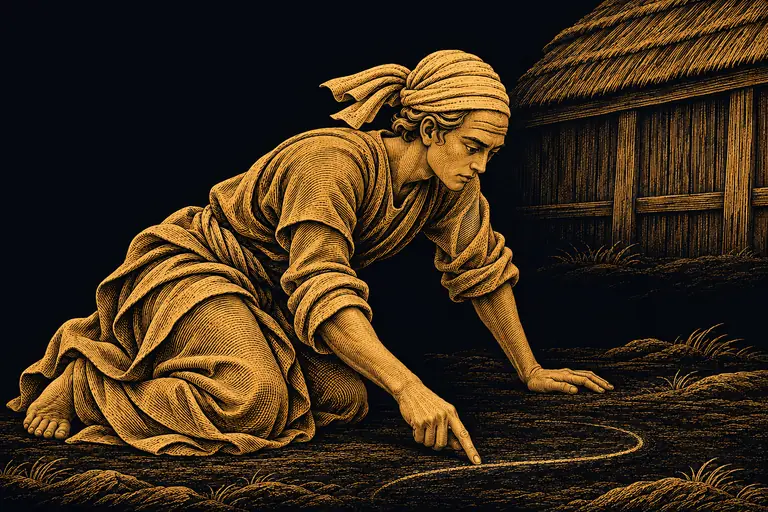
A Gilded card in this set is an engraving: the same card cut again in gold line on near-black by an engraver who wanted to remember a telling. The gold is the engraver's material, the same in all ten sets.
A Gilded card is an engraving: a plate cut in gold line on near-black by someone who wanted to remember an evening's telling. All ten sets share one engraver's hand. Few exist because a plate takes a long time to cut, not because its subject is worth more than any other.
The gold belongs to the engraver, not to the story or the culture. A Gilded card never changes the rules, and the gold adds nothing to the figure it shows.
Every card has a Base face, made in its own culture's craft: lacquer and shell for Korea, red-figure for Greece, silver and niello for Ireland, grass cord for the Andes.
Bench-End Youth (NOR-001), Norse. Base in Stamped foil plaques (Vendel-period pressblech). The current review renames it Þjálfi and Röskva.
Signature cards
The cards that, more than any others, make this set Norse.
What comes after the end: the earth, green again out of the sea.
How the set tells it
The set divides its 250 cards among the cycles roughly as the sources do: close to a third for Odin and Thor, a large share for the end and the green earth after it, and about thirty for the Völsung heroes, whose poems fill half the Poetic Edda. The draft gave six gods cards of their own. On review advice this page treats them like every other god and goddess, as places, events and things made, never as playing pieces. Rune glyphs and the hammer as an emblem are left out of the art.
The review mapped all 250 cards: 4 kept as they were, 120 given a truer scene, 126 given to a missing story, 0 proposed for a cut.
What the set still lacks
Gerðr, Freyja and Guðrún are still shown more through what they own or lose than through what they do.
Hel is present through her hall, her gate and her terms, but is never shown herself.
Many places are still missing, among them Breiðablik, Himinbjörg, Bilskirnir and Gimlé.
Hávamál has only four cards, and Bragi, Ullr, Forseti and Váli have none.
Cosmogony10
The World-Ash, its creatures, the norns and the well-court10
The first war, the truce and the wall of Ásgard9
Odin's quests38
Thor's journeys21
Útgarða-Loki and the Gylfi frame14
Loki, the dwarves' gifts, Ægir's feast, the binding15
The binding of Fenrir7
Iðunn and Þjazi5
The Vanir13
Heimdallr, the bridge and Ríg12
Baldr's death and funeral11
Hel's realm and the Hel-road8
Sun, moon, day, night and the wolves11
Ragnarök25
The world reborn6
Völsungs and Gjúkungs25
Other heroic legend6
Hávamál wisdom and the human setting4
Cards per canon element, from the set's review.
Sources and care
Norse myth reaches us mostly through Christian Iceland. The Eddas were written down in the 13th century, more than two centuries after the island's conversion, by learned authors looking back on a pre-Christian world, and they do not speak for every region or person. Some of these gods and other powers are honoured in present-day Heathen practice. An independent review advises that none of them, including the six gods drafted with cards of their own and any thin disguise of them, should be a playing piece. Rune glyphs, the hammer as an emblem and other signs misused by hate groups are kept out of the art. Outside advisers have still to read the set.
An independent expert review graded the proposed cards C: keep the narrative backbone; do not lock the roster or commission the sheets as written. Its corrections are being worked through before the list is locked. The retellings here leave out details the review marked for checking, though some cards listed on this page still have such details open.
Lines the cards quote
Every quotation on this page and its cards comes from a public-domain translation, checked against the source text.