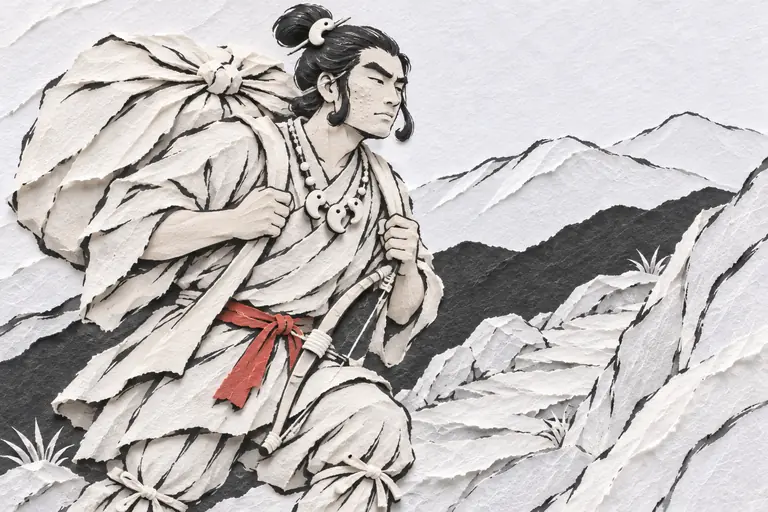
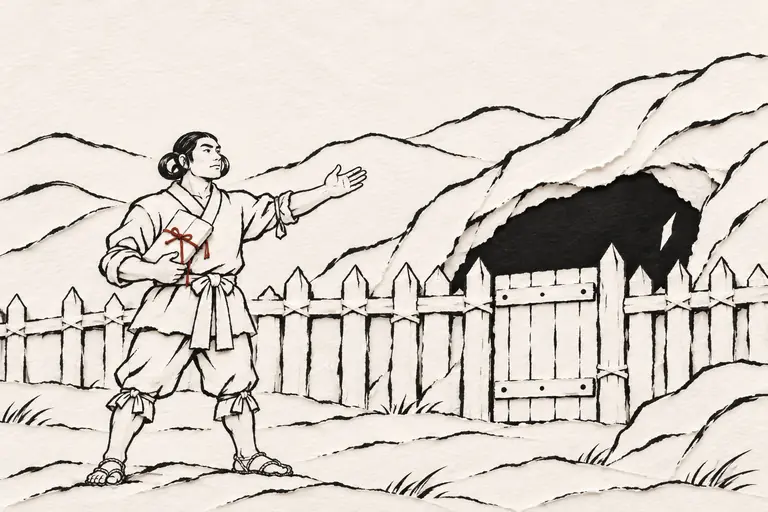
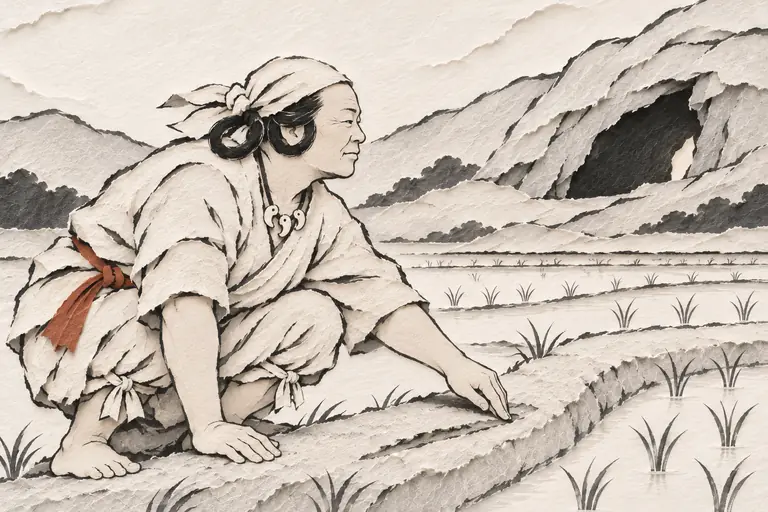
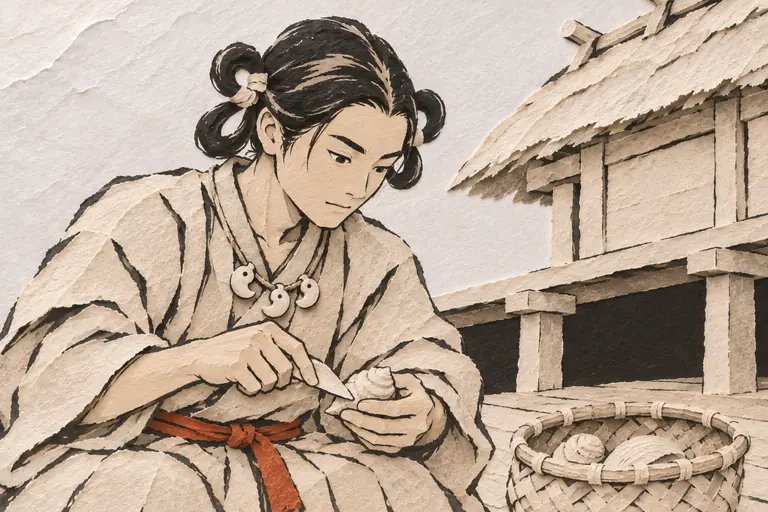
River Mouth at Tachibana: Base art in Torn and layered washi with sumi line (chigiri-e)Base art from card JPN-011, in Torn and layered washi with sumi line (chigiri-e)Base art from card JPN-012, in Torn and layered washi with sumi line (chigiri-e)River Mouth at Tachibana: Base art in Torn and layered washi with sumi line (chigiri-e)Long-Crowing Bird of the Eternal Land: Base art in Torn and layered washi with sumi line (chigiri-e)Base art from card JPN-011, in Torn and layered washi with sumi line (chigiri-e)Base art from card JPN-012, in Torn and layered washi with sumi line (chigiri-e)Base art from card JPN-010, in Torn and layered washi with sumi line (chigiri-e)River Mouth at Tachibana: Base art in Torn and layered washi with sumi line (chigiri-e)Base art from card JPN-011, in Torn and layered washi with sumi line (chigiri-e)
Japanese mythology
The light behind the rock door
The myths of the Kojiki tell how the islands were made, how death and washing began and how the hidden sun was coaxed out, and this page follows them.
The set
The Reed Plain and the Rock Door, JPN
Base craft
Torn and layered washi with sumi line (chigiri-e)
Cards
250
River Mouth at Tachibana: Base art in Torn and layered washi with sumi line (chigiri-e)
The tradition
Japan's oldest written myths are in the Kojiki, compiled for the court in 712, and in the Nihon shoki of 720. Their first books tell the age of the kami: the making of the islands, the land of the dead, the sun hiding behind a door of rock, Susanoo and the serpent, the lord of Izumo and the descent from heaven. Provincial records, court tales, warrior legends, village folktales and the yokai of later picture books add further layers. Japanese scholars keep myth, legend and folktale apart.
Many of these kami are worshipped today at Shinto shrines, among them the great shrine of Izumo, and Shinto washing rites, misogi, look back to Izanagi bathing after his visit to the dead. The tradition also lives in stories the Kojiki does not tell: how Inari, Hachiman and Tenjin came to dwell among people, Buddhist tales of mercy, and folktales such as Momotaro. What holds it together is a concern with clean and unclean, with places where kami are present, and with what follows a forbidden look.
Torn and layered washi with sumi line (chigiri-e)
Chigiri-e builds a picture from layers of torn and cut washi paper. Each card here is cool white paper with confident sumi brush lines, one solid mass of ink and a single small vermilion accent, leaving large calm areas of empty paper. Torn edges and open paper suit stories of water, rope, cloth and light. The figures wear Kofun-period dress, an art convention and not a date for the myths.
Sources
Kojiki712ChronicleSet down by O no Yasumaro from Hieda no Are's recitation. Its first book tells the age of the kami.
Nihon shoki720ChronicleThe court's official history, written in Chinese, giving variant tellings of many myths beside its main account.
FudokiFrom 713Provincial recordProvincial records ordered in 713. Izumo's survives whole, with its land-pulling myth. Others survive in part or in quotation.
Taketori monogatari9th–10th centuryTaleThe tale of an old bamboo cutter and Kaguya-hime, the girl who came from the moon.
Otogi-zoshiMuromachi period and afterIllustrated taleShort illustrated tales of heroes, monsters and village people, among them a boy one inch tall.
Gazu hyakki yagyo1776Picture bookToriyama Sekien's illustrated catalogue of yokai, each drawn and named on its own page.
Themes
Stain and washing
Contact with death and violence leaves a stain, and water and the turn of the season take it away. Izanagi, back from Yomi, washed at a river mouth, and kami were born from the washing. In a provincial record a travelling kami sheltered by the poor man Somin Shorai came back years later, had Somin's daughter wear a ring of reeds, and promised that wearers would be spared in future plagues.
Again and again someone asks not to be watched, and someone looks. Izanagi lit a tooth of his comb and looked at Izanami in Yomi. Hoori looked into the birth hut and saw Toyotama-hime in her own form, and she went home to the sea. In some tellings of a village folktale, a crane who has come as a wife weaves on condition that no one watches, and when she is seen she flies away.
When someone flees, what they throw behind them becomes a barrier. Izanagi threw down his headdress, which became grapes, and pieces of a comb, which sprouted bamboo shoots, then three peaches, and at last he closed the pass with a great rock. In a village folktale a young temple novice running from a mountain hag throws down paper charms from his temple, and they turn into obstacles in her way.
Tricks run through these stories, and they are seldom free. The hare of Inaba fooled the wani into a line and was stripped for boasting. Susanoo's vats of strong sake put the serpent to sleep. In village tales a monkey cheats a crab out of a rice ball, and the crab's children pay him back with help from a chestnut, a bee and a mortar, while a hare repays a cruel tanuki with fire.
Beside the kami stand the yokai of later folklore. Oni guard plundered goods on their island until a boy and his animals come. In an early Buddhist tale collection a fox takes a woman's form, marries, and leaves when a dog exposes her. Old trees may hold a spirit. In a children's telling a tanuki turned tea-kettle performs to repay a kindness, and in sailors' tales the drowned ask for a ladle.
9 stories, in reading order, each with the cards that carry it.
Izanagi and Izanami make the islands
Creation · Kojiki, Book 1, the opening sections, tr. Chamberlain (1882)
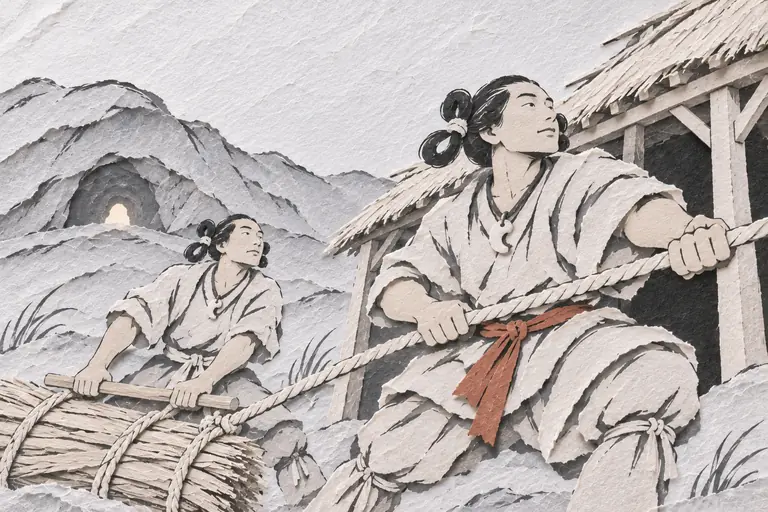
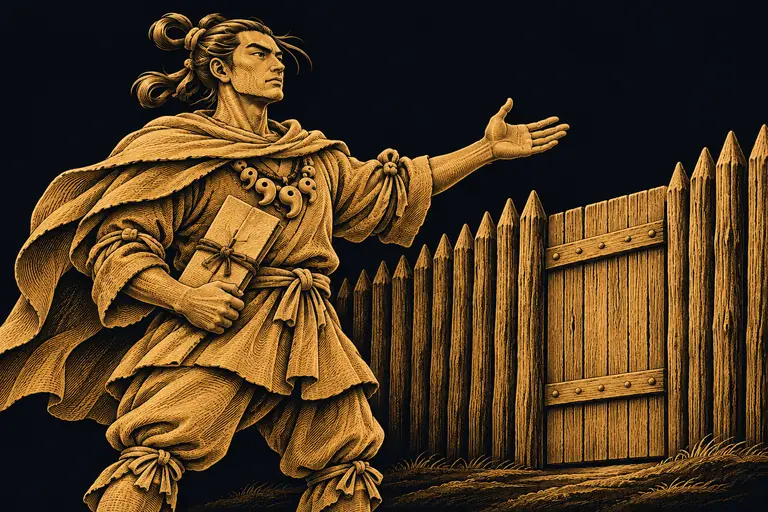
Base art from card JPN-011, in Torn and layered washi with sumi line (chigiri-e)
At first the land was young and drifted like oil on water, like a jellyfish, and from it something sprouted like a reed shoot. The kami of heaven sent a pair, Izanagi and Izanami, to give the land form. Standing on the bridge that floats in heaven, they stirred the brine with a jewelled spear, and the drops from its tip piled up into Onogoro, the first island. There they raised a pillar and walked around it to marry. The first time, the rite went wrong, and their first child was a leech-child, whom they set adrift in a boat of reeds. They asked heaven, went round again, and gave birth to the islands and to many kami. The last was the kami of fire, whose birth burned Izanami, and she withdrew from the world.
The story shows a world made by stirring brine and by a rite done twice, and it closes on the first death.
In MYTH the central figure of this story appears as places, events and blessings, never as a playing piece.
Yomi · Kojiki, Book 1, the visit to Yomi, tr. Chamberlain (1882)
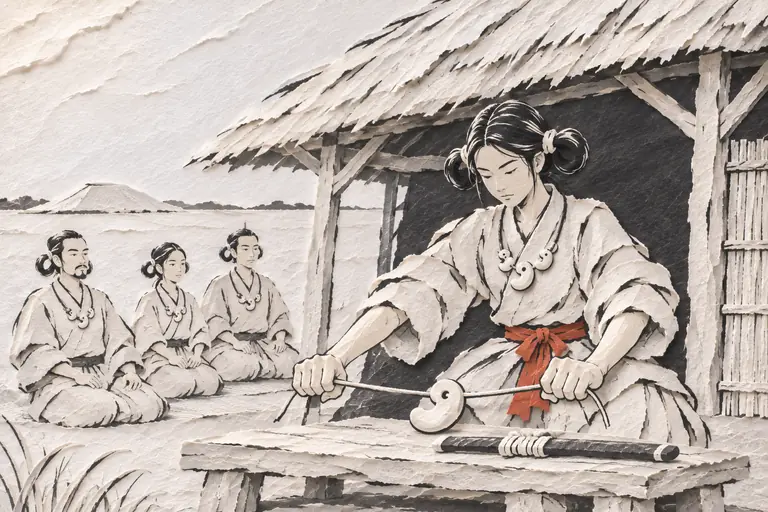
Base art from card JPN-012, in Torn and layered washi with sumi line (chigiri-e)
Izanagi followed Izanami to Yomi, the land of the dead. She told him at a door that she had eaten at the hearth of Yomi, but would ask its gods to let her go, if he would not look at her. Then he lit a tooth of his comb and looked in, and what he saw made him run. Shamed, she sent the hags of Yomi after him, then eight thunders and a host of warriors. He threw down his headdress, which became grapes, and pieces of another comb, which sprouted bamboo shoots, and the hags stopped to eat. At the pass three peaches turned the host back, and Izanami came after him herself. He closed the pass with a great rock. Across it she said she would take a thousand lives a day, and he answered that he would set up fifteen hundred birth huts a day.
The story shows a promise broken by one look, and it ends with death and birth set against each other, birth the larger.
In MYTH the central figure of this story appears as places, events and blessings, never as a playing piece.
Purification · Kojiki, Book 1, the purification, tr. Chamberlain (1882)
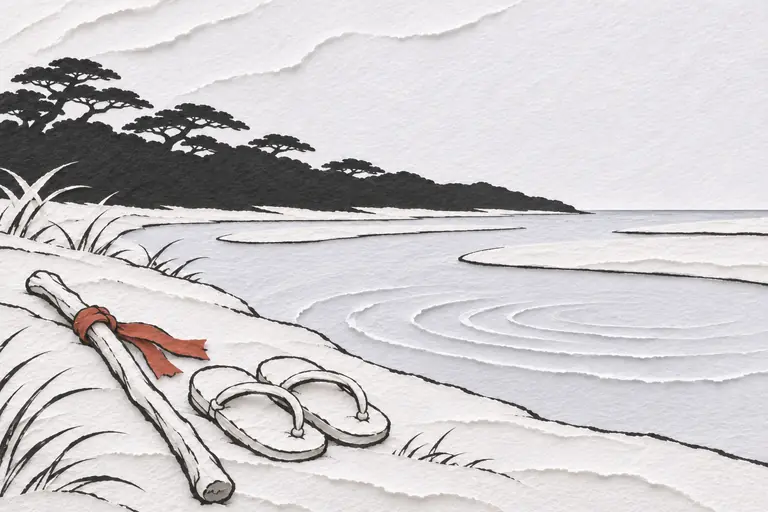
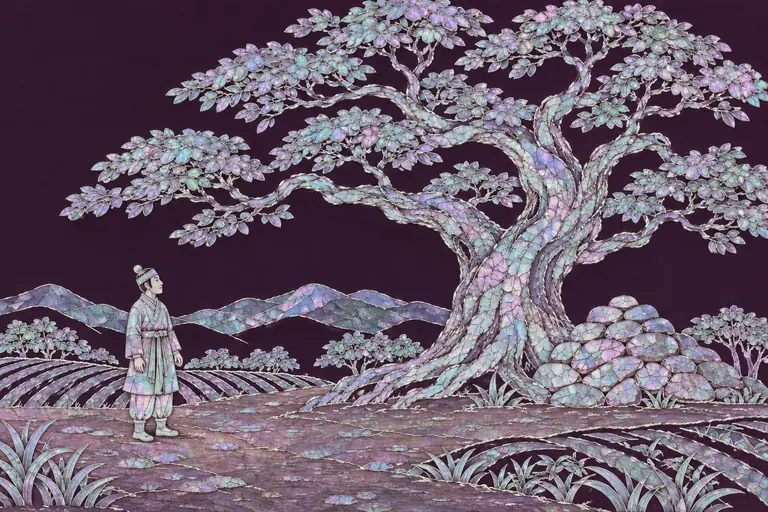
River Mouth at Tachibana: Base art in Torn and layered washi with sumi line (chigiri-e)
Back from Yomi, Izanagi felt the stain of the dead land on him and went to wash at the mouth of a river at Tachibana, in Tsukushi in the far south-west. First he threw down his staff, then his sash, robe, trousers, headdress and bracelets, and a kami was born from each. He went into the middle of the current and washed, and more kami were born from the water. Last of all, when he washed his left eye, Amaterasu, kami of the sun, was born. From his right eye came Tsukuyomi, kami of the moon, and from his nose Susanoo. Izanagi gave Amaterasu the high plain of heaven, Tsukuyomi the realm of night and Susanoo the sea. Susanoo did not take up his charge. He wept until the green mountains withered, longing for his dead mother's land.
The story shows a stain washed away in running water, and great kami born from the washing itself.
…at a small river-mouth near Tachibana in Himuka in [the island of] Tsukushi, and purified and cleansed himself…
In MYTH the central figure of this story appears as places, events and blessings, never as a playing piece.
The rock door · Kojiki, Book 1, tr. Chamberlain (1882), sects. XIII–XVI
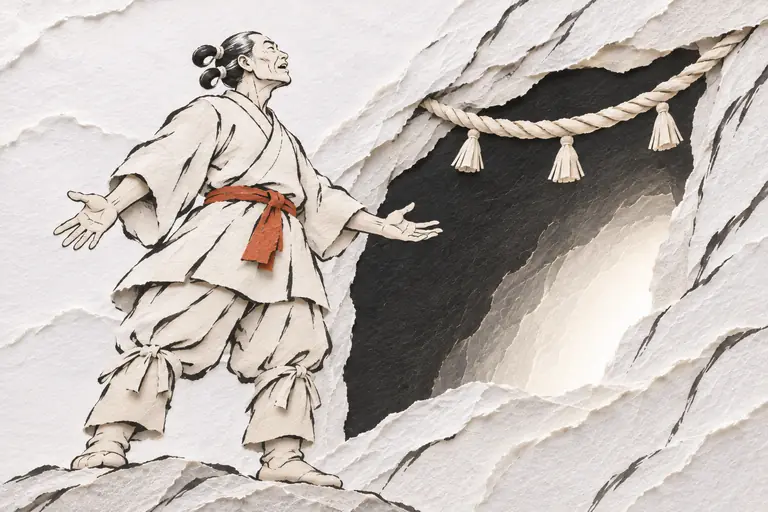
Long-Crowing Bird of the Eternal Land: Base art in Torn and layered washi with sumi line (chigiri-e)
Susanoo went up to heaven to take leave of his sister. Amaterasu met him armed, and across the river of heaven they made a pledge: she broke his sword and breathed out three goddesses, and he chewed her beads and breathed out five gods. Claiming he had won, he ran wild, breaking her rice-field dykes and flinging a flayed horse through the roof of the weaving hall, where a weaving maiden died. Amaterasu shut herself in a cave of rock, and all went dark. The eight hundred myriad kami met in the riverbed and made a plan. Long-crowing birds crowed, cloth hung from a sakaki tree, and Ame-no-Uzume, possessed, danced on an upturned tub with her clothes loosened until the assembly roared with laughter. Amaterasu leaned out to ask why, and a strong hand drew her out. A straw rope was stretched across the door behind her.
The story shows light coaxed back with birdsong, cloth, a dance and loud laughter, after a brother's rampage had driven it away.
…assembling the long-singing birds of eternal night and making them sing…
…drew the bottom-tied rope along at her august back…
In MYTH the central figure of this story appears as places, events and blessings, never as a playing piece.
Izumo · Kojiki, Book 1, tr. Chamberlain (1882), sects. XVIII–XIX
Base art from card JPN-011, in Torn and layered washi with sumi line (chigiri-e)
Driven out of heaven, Susanoo came down beside the river Hi in Izumo. Seeing chopsticks float past, he knew people lived upstream, and there he found an old man and woman weeping beside their daughter, Kushinada-hime. Each year an eight-forked serpent, Yamata-no-Orochi, had taken one of their eight daughters, and now its time had come again. Moss and cedars grew on its back. Susanoo asked for the girl as his wife and turned her into a comb, which he wore in his hair. He had the old couple brew sake eight times over and set it in eight vats behind a fence with eight gates. The serpent came, put a head into each vat, drank and fell asleep, and Susanoo cut it to pieces. Then he built a palace at Suga, where clouds rose, and sang a song of rising clouds, later honoured as an origin of Japanese poetry.
The story holds up cleverness that spares a life, and it shows the expelled storm god settling down to build a home and make a song.
In MYTH the central figure of this story appears as places, events and blessings, never as a playing piece.
Izumo · Kojiki, Book 1, tr. Chamberlain (1882), sects. XXI–XXII
Base art from card JPN-012, in Torn and layered washi with sumi line (chigiri-e)
A hare on an island off Inaba wanted to cross to the mainland. It told the wani of the sea it would count their kin against its own, and they lay in a line across the water. The hare hopped along their backs, counting, and just before it landed it boasted of the trick. The last wani caught it and stripped it bare. Onamuji's brothers, the eighty kami, on their way to court Yagami-hime of Inaba, told the hare to bathe in salt water and lie in the wind. Onamuji, the youngest, who carried their bags, told it to wash in fresh water and roll in cattail pollen, and it was healed. The hare foretold that he would win the princess, and she chose him. The angry brothers twice took his life, and twice his mother had him brought back. In time he became Okuninushi, honoured today at Izumo.
The story holds up plain kindness to a suffering animal, and it lets the one who carried the bags be the one who is chosen.
In MYTH the central figure of this story appears as places, events and blessings, never as a playing piece.
The yielding of the land · Kojiki, Book 1, tr. Chamberlain (1882), sect. XXXI
Base art from card JPN-010, in Torn and layered washi with sumi line (chigiri-e)
In the Kojiki's telling, heaven decided that the land below, which Okuninushi ruled, should be governed from heaven, and sent envoys to say so. The first sided with Okuninushi and sent no word for three years. The second, Ame-no-Wakahiko, was given a bow and feathered arrows from heaven. He married Okuninushi's daughter and sent no word for eight years. A pheasant was sent down to ask why. It perched by his gate, and he shot it with the heavenly bow. The arrow went through the bird and up to heaven, where it was found and thrown back down, to strike him only if he had turned false. It struck him as he slept. At his mourning the birds took the funeral's offices: a heron carried the broom, a kingfisher the food, a sparrow pounded the rice and a pheasant wept. In the end the land was yielded.
The story shows a messenger who forgot his message, and an arrow that judged him by what he had done.
…the heavenly true deer-bow and the heavenly feathered arrows…
In MYTH the central figure of this story appears as places, events and blessings, never as a playing piece.
The descent from heaven · Kojiki, Book 1, tr. Chamberlain (1882), sects. XXXVII–XXXVIII
River Mouth at Tachibana: Base art in Torn and layered washi with sumi line (chigiri-e)
Ninigi, grandson of the sun goddess, came down from heaven to the land below. There he met a young woman, Konohanasakuya-hime, whose name speaks of trees in flower, and asked to marry her. Her father, the great kami of the mountains, gladly sent her with her elder sister, Iwanaga-hime, whose name speaks of rock, and with a hundred tables of gifts. Ninigi kept the younger sister and sent the elder home. Her father had sent both, he said, so that the lives of Ninigi's line would last like rock and bloom like blossom. Because only the blossom was kept, their lives would be brief. When Konohanasakuya conceived after a single night, Ninigi doubted the child was his. She answered by vowing that his child would come to no harm, sealed herself in a hall with no door, set it alight and bore her sons inside the fire.
The story gives the Kojiki's reason why the lives of Ninigi's line are short: blossom chosen over rock, once and for good.
In MYTH the central figure of this story appears as places, events and blessings, never as a playing piece.
Luck of the sea and the mountain · Kojiki, Book 1, tr. Chamberlain (1882), sects. XXXIX–XLII
Base art from card JPN-011, in Torn and layered washi with sumi line (chigiri-e)
Of Konohanasakuya's sons, Hoderi fished and Hoori hunted. Hoori pressed his brother to exchange tools, then lost the hook in the sea. He broke his sword into five hundred hooks, then a thousand, but his brother would take only his own. An old kami of the tides made him a close-built boat and set him on the sea road to the palace of the sea kami, whose daughter, Toyotama-hime, he married. After three years the hook was found in a bream's throat. The sea kami gave him jewels that raised and lowered the tide, and with them he humbled his brother. Toyotama-hime came ashore to give birth and asked him not to look. He looked, saw her in her own form as a great wani, and she went back to the sea and closed its border. Even so, she sent him a song.
The story shows a debt that no substitute could pay, and another forbidden look that closed the road between land and sea.
In MYTH the central figure of this story appears as places, events and blessings, never as a playing piece.
In the Gilded edition each card is an engraving in gold line on near-black, cut to remember a telling. The gold belongs to the engraver, not to the story, and a Gilded card is the same card as its Base.
A Gilded card is an engraving: a plate cut in gold line on near-black by someone who wanted to remember an evening's telling. All ten sets share one engraver's hand. Few exist because a plate takes a long time to cut, not because its subject is worth more than any other.
The gold belongs to the engraver, not to the story or the culture. A Gilded card never changes the rules, and the gold adds nothing to the figure it shows.
Every card has a Base face, made in its own culture's craft: lacquer and shell for Korea, red-figure for Greece, silver and niello for Ireland, grass cord for the Andes.
Herald of the Assembly (JPN-001), Japanese. Base in Torn and layered washi with sumi line (chigiri-e). The current review renames it Old Man Who Danced for the Oni.
Signature cards
The cards that, more than any others, make this set Japanese.
The palace under the sea, where a lost hook leads to a marriage.
How the set tells it
About seven cards in ten follow the first book of the Kojiki, from Onogoro to the sea palace, with the rock door, the sea palace and the hare told at most length. Smaller shares draw on provincial records, court legend, folktales and yokai. Enshrined kami, from Amaterasu and Susanoo to the dancer at the door and the hare of Inaba, appear as places, events and blessings, not as playing pieces, and named figures with shrines of their own are being moved to the same form. By choice the set never shows the three regalia as objects, and it leaves Ainu and Ryukyuan traditions to their own peoples.
The review mapped all 250 cards: 92 kept as they were, 22 given a truer scene, 124 given to a missing story, 12 proposed for a cut.
What the set still lacks
Two objects at the heart of the serpent story and the rock door are shown only by their edges, under the set's regalia rule.
No story yet tells how Inari, Hachiman or Tenjin came to dwell among people, or how kami and buddhas came to be honoured together.
Buddhist tales of mercy and of care for the dead, and the voices of the provincial records, still have too few cards.
The slaying of the fire child, after Izanami's death, has no card.
A9
B14
C8
D8
E6
F21
G8
H16
I19
J10
K9
L18
M8
N20
O9
P13
Q25
R14
S15
Cards per canon element, from the set's review.
Sources and care
Many kami in these stories are worshipped today at Shinto shrines. Amaterasu, Susanoo, Izanagi, Izanami, Okuninushi, the dancer at the rock door and other enshrined figures appear only as places, events and blessings, never as playing pieces. The three regalia are never shown as objects, and Yomi is shown without corpses. The Kojiki and Nihon shoki were compiled for the Yamato court in the early 8th century and arrange older traditions around the ruling house's descent from heaven, and modern governments later used them for state ideology. The set leaves that framing aside. An outside review found that some figures proposed as pieces, Shuten-doji and Benkei among them, receive prayers today and must become world cards. That change, a Shinto adviser's review and shrine checks come first.
An independent expert review graded the proposed cards C: revise before lock. Its corrections are being worked through before the list is locked. The retellings here leave out details the review marked for checking, though some cards listed on this page still have such details open.
Lines the cards quote
Every quotation on this page and its cards comes from a public-domain translation, checked against the source text.
…the eight hundred myriad Deities assemble in a divine assembly in the bed of the Tranquil River of Heaven…
Then the Plain of High Heaven shook, and the eight hundred myriad Deities laughed together.
…swore to each other from the opposite banks of the Tranquil River of Heaven…