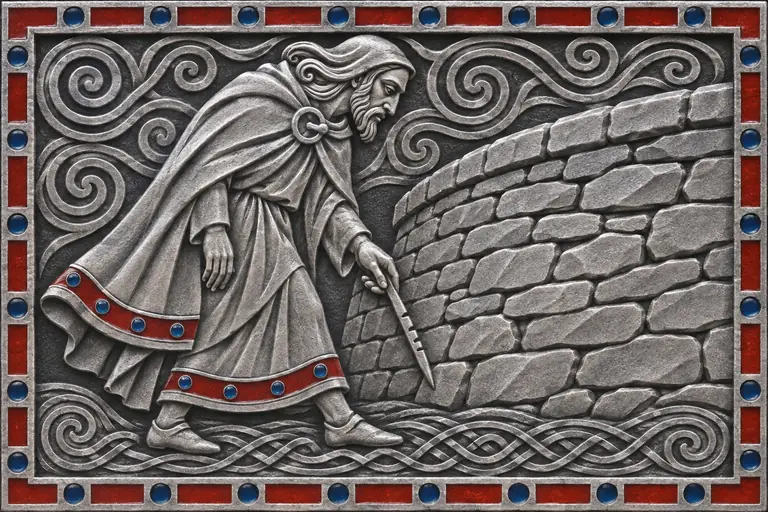
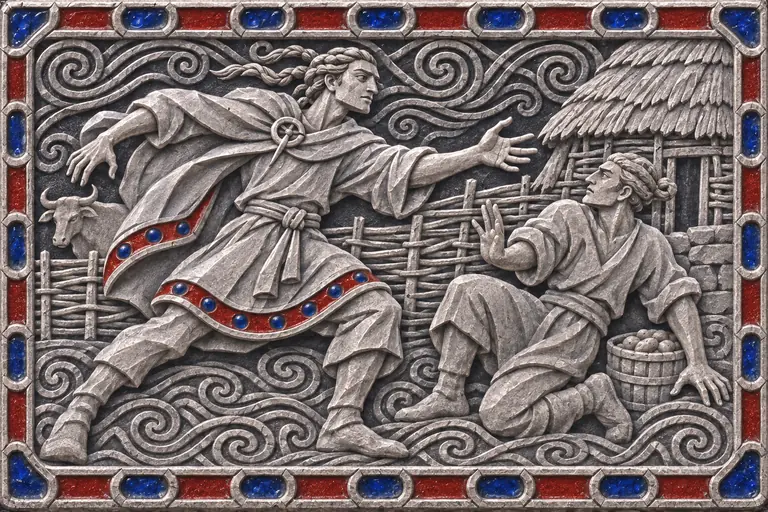
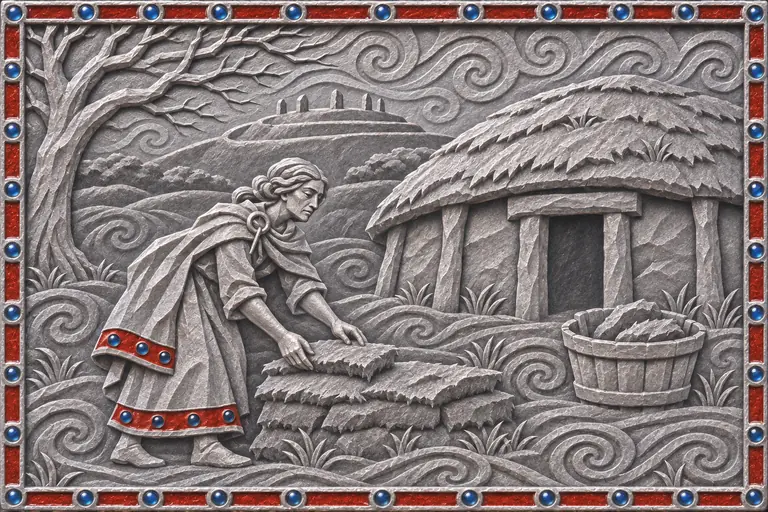
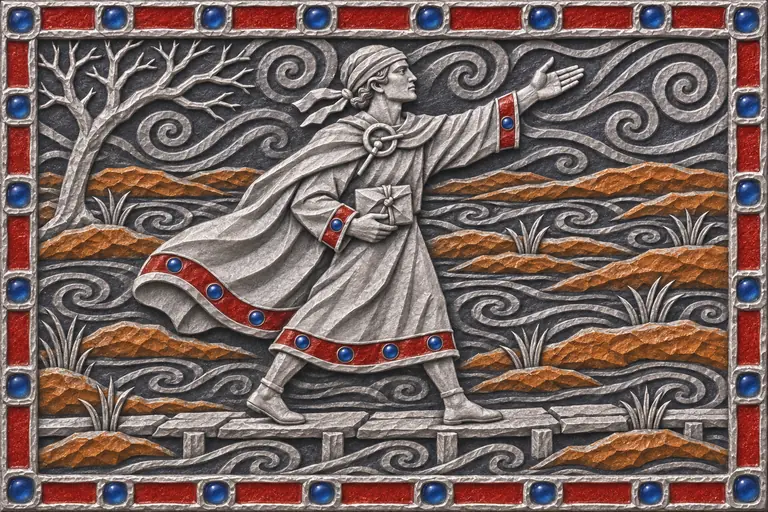
Tara's Door: Base art in Insular silver with gilt bands and studsBase art from card IRL-003, in Insular silver with gilt bands and studsSpirit of a King in Every Man: Base art in Insular silver with gilt bands and studsSpirit of a King in Every Man: Base art in Insular silver with gilt bands and studsDoorkeeper of Tara: Base art in Insular silver with gilt bands and studsBase art from card IRL-011, in Insular silver with gilt bands and studsBase art from card IRL-006, in Insular silver with gilt bands and studsBase art from card IRL-082, in Insular silver with gilt bands and studsTara's Door: Base art in Insular silver with gilt bands and studsBase art from card IRL-003, in Insular silver with gilt bands and studs
Irish mythology
Geasa, sovereignty and the síd
Medieval Irish tales of gods, heroes and kings, where one forbidden act can undo a life: their sources, their themes, nine stories and the cards that carry them.
The set
Geasa and Sovereignty, IRL
Base craft
Insular silver with gilt bands and studs
Cards
250
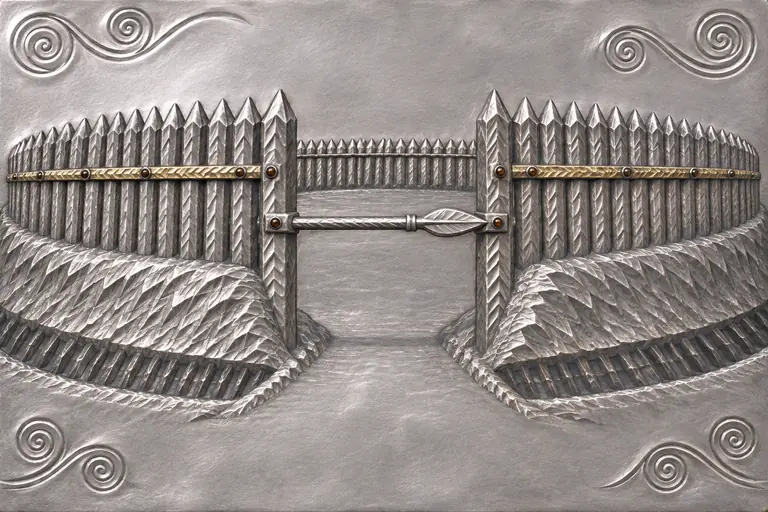
Tara's Door: Base art in Insular silver with gilt bands and studs
The tradition
Irish mythology reaches us as medieval prose and verse in the Irish language, copied by monastic scribes into manuscripts from about 1100 onward. Scholars sort it into four cycles: the Mythological Cycle of the Tuatha Dé and their rivals the Fomorians, the Ulster Cycle of Conchobar's court and Cú Chulainn, the Fenian Cycle of Finn and his band, and the Cycles of the Kings. No separate pre-Christian account of the world's making survives. The learned Book of Takings starts from the biblical Creation and follows the peoples who took the island.
These stories are part of Irish life today. Irish speakers read and retell them, schools teach them, and place-names such as Tara, Uisnech and Brú na Bóinne keep them on the map. A handful of ideas hold them together. There is the geis, a binding prohibition laid on one person, and the rightful king who brings peace and harvest. There is the duty of hospitality and the force of a poet's satire. And there is the síd, the otherworld inside the hills, never far away.
Insular silver with gilt bands and studs
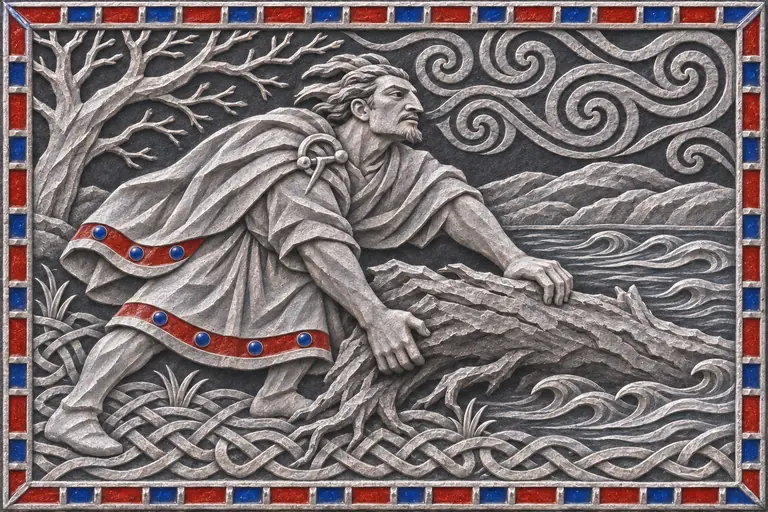
Bright polished silver, chip-carved in shallow relief, with black niello in every cut line, two gilt bands and a few studs of amber, blue glass and red enamel. The style follows Irish church metalwork of the eighth and ninth centuries, such as the Ardagh chalice and the Derrynaflan paten. Its plain fields and crisp spirals suit tales that are formal, bright and exact.
Sources
Lebor na hUidrec. 1100ManuscriptCopied at Clonmacnoise. It holds the oldest surviving text of the Táin and the tale of Da Derga's hostel.
Book of Leinsterc. 1160ManuscriptA large learned compilation with a fuller Táin, a version of the Lebor Gabála and many poems of place-lore.
Cath Maige TuiredMedieval, composed over centuriesSagaThe second battle of Mag Tuired: Bres's mean reign, Lug at the door of Tara, and the war with the Fomorians.
Lebor Gabála Érennc. 11th centuryLearned historyThe Book of Takings: a learned history that opens with the biblical Creation and runs to the sons of Míl.
Acallam na Senórachc. 1200Frame taleOld members of the Fianna walk Ireland telling the stories of its places. A main early source for Finn.
Oidheadh Chloinne LirEarly modernTaleA later, openly Christian tale of Lir's four children turned into swans. The set labels it as late.
Themes
The one thing you must never do
A geis is a binding prohibition, or sometimes a command, laid on one person. Keep it and you may be stronger than anyone. Break it and the story turns against you. Conaire's geasa fall one after another on a single road. Cú Chulainn is forbidden dog's flesh, yet when three crones roasting a hound taunt him for passing their fire, he takes what they offer, and his last day turns against him.
In these tales the right to rule is given, and the giver sets the terms. Niall and his brothers find a well kept by a hag who asks for a kiss. A brother offers a grudging one, but Niall embraces her fully, and she becomes the fairest of women, names herself Sovereignty and foretells the kingship of his line. At Tara the Stone of Fál cries out under a rightful king.
A poet's words could ruin a mean host. When Bres gave the poet Coirpre a dark hut and dry cakes, Coirpre's verse was the first satire made in Ireland, and Bres's good fortune left him. Feasts are where trouble starts. Bricriu promised the champion's portion to three heroes at once, and in Mac Da Thó's hall Cet shamed each Ulsterman who rose to carve the pig. Da Derga's hostel never closed its doors.
The people of the síd live inside the mounds, a short walk from any farm. One Samain night at Crúachan, Nera followed a host of the síd into the cave there and lived among them. Óengus won the Brug on the Boyne from Elcmar by asking for it for a day and a night, then keeping it, since all time is days and nights. In a late lay, Oisín returns from the Land of Youth.
Fosterage made bonds as strong as kinship, and a river ford is where such bonds are tested. The boy Sétanta killed the smith Culann's hound and offered to guard the house himself, and so took the name Cú Chulainn. In the Táin he fought his foster-brother Fer Diad at a ford for days, sharing food each evening. On a strand, though Emer warned him, he faced Connla, the son he had never met.
Base art from card IRL-003, in Insular silver with gilt bands and studs
No separate pre-Christian account of the world's making survives. The Book of Takings sets Ireland inside biblical history and tells how peoples came to the island one after another. Partholón's people cleared the first plains, ploughed them and fought the Fomorians, a people from over the sea, before plague ended them. Nemed's people rose against Fomorian demands for two-thirds of their corn, milk and children, and stormed Conand's tower on its sea-rock as the tide came in over both hosts. The Fir Bolg came next and held the land until the Tuatha Dé arrived in darkness. At the first battle of Mag Tuired, the Fir Bolg champion Sreng cut off King Nuada's arm. Fintan, who came before the Flood, and Túan, who outlived Partholón's people, survived in changing shapes to tell it later.
The story writes Ireland into a learned history of the world, as a long line of arrivals, with witnesses kept alive to remember.
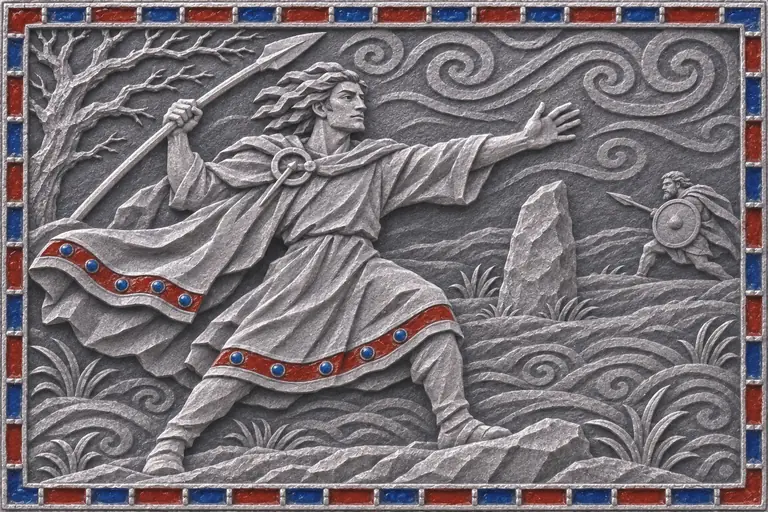
Spirit of a King in Every Man: Base art in Insular silver with gilt bands and studs
With his arm gone, Nuada could no longer be king, since a king had to be unblemished. The Tuatha Dé chose Bres the Beautiful, whose father was a Fomorian king. Under Bres the Fomorians laid dues on every roof that smoked, and his guests left with dry knives and no ale on their breath. When the poet Coirpre was given a dark hut and three dry cakes, he made Ireland's first satire, and Bres's luck turned. Bres was put out. Then Lug came to the door of Tara claiming every art at once. In the battle that followed, a stone from Lug's sling drove Balor's opened eye through his head toward his own host. Bres, taken alive, bought his life by naming Tuesday as the day to plough, sow and reap. Lug has devotees today, so he is told here through events, never as a piece.
The story holds up generosity as a king's first duty, and shows a gate that asks what you can do, and a stranger who can do everything.
In MYTH the central figure of this story appears as places, events and blessings, never as a playing piece.
Mythological Cycle · Lebor Gabála Érenn and De Gabáil in t-Sída
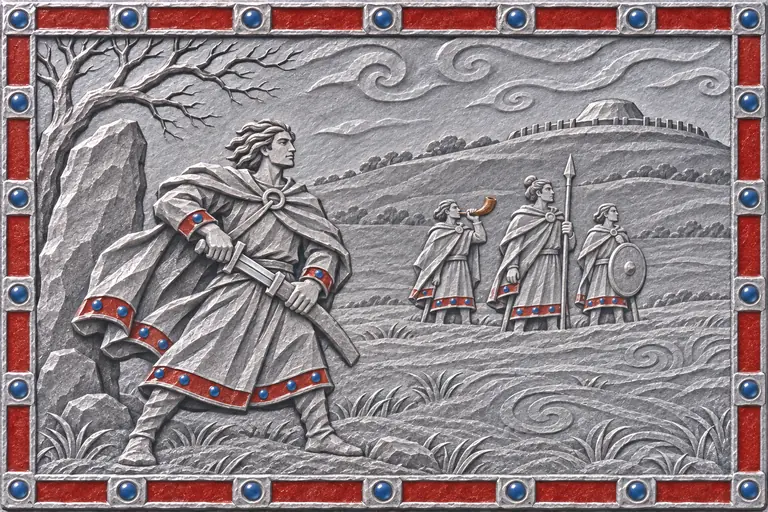
Spirit of a King in Every Man: Base art in Insular silver with gilt bands and studs
From Breogán's tower, on a winter evening, Íth saw Ireland across the sea, and the sons of Míl sailed for it. Three queens of the Tuatha Dé met them, Banba, Fótla and Ériu, each asking that the island bear her name, and Ériu at Uisnech was promised it. The Tuatha Dé asked the newcomers to withdraw beyond the ninth wave and land again if they could, and the poet Amorgen judged this fair. Druids raised a wind that drove the ships back. Donn, eldest of Míl's sons, drowned, and a rock off the western coast is called his house. Amorgen sang to the land and the sea grew calm. The sons of Míl came ashore and won, and the island was shared: they took the land above, and the Tuatha Dé went into the hills and mounds of the síd.
The story shows a land won by a fair judgement as much as by force, and an older people who stay close, just under the hills.
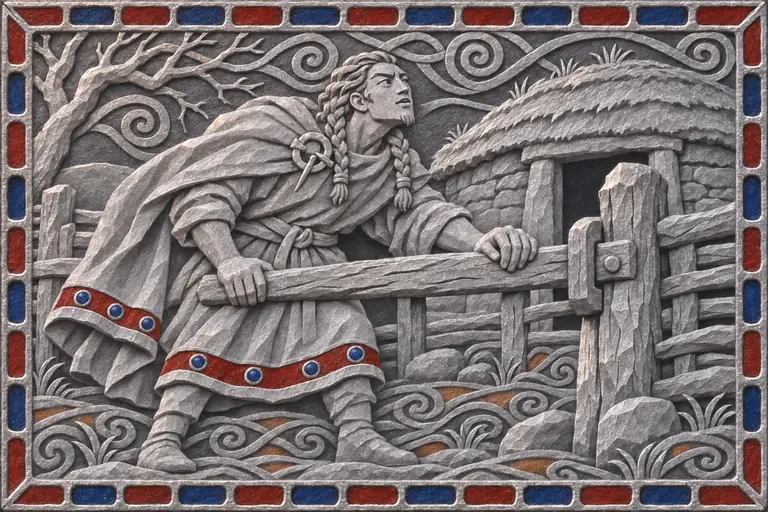
Doorkeeper of Tara: Base art in Insular silver with gilt bands and studs
Midir of Brí Léith, a lord of the síd, took Étaín as his second wife. His first wife, Fuamnach, struck her with a rod of scarlet rowan, and she became a pool, then a worm, then a purple fly as large as a man's head, whose humming soothed all who heard it. A wind drove her over Ireland for seven years, and Óengus sheltered her for a time. At last she fell into a cup, was swallowed by the wife of the champion Étar, and was born again as a mortal girl, more than a thousand years after she was first begotten. She married Eochaid Airem, king of Tara. Midir played him at fidchell, the winner of the last game to ask what he wished. Midir won and asked for an embrace and a kiss. He took Étaín up through the skylight, and two swans were seen circling Tara.
The story shows the otherworld close beside the everyday one, and a stake honoured to the letter even when the loser could see what was coming.
Tales of the síd · Oidheadh Chloinne Lir (early modern, openly Christian)
Base art from card IRL-011, in Insular silver with gilt bands and studs
Lir of the Tuatha Dé had four children, a daughter, Fionnghuala, and three sons. After their mother died he married her sister Aoife, who came to resent the love he gave them. At Loch Dairbreach she struck the children with a druid's wand and they became swans, bound to spend three hundred years on that lake, three hundred on the Sea of Moyle and three hundred off the western coast. They kept their human voices, and their singing eased all who heard it. Aoife was sent away on the wind for ever. On the winter sea Fionnghuala sheltered her brothers, two under her wings and one at her breast. When the nine hundred years were over, Christianity had come to Ireland. They heard its bell, the feathers fell away, and four very old people were baptised before they died.
The story holds up an elder sister's care through every year of a long sentence, and lets time pass in full.
Base art from card IRL-006, in Insular silver with gilt bands and studs
At a feast in Ulster the unborn child of the host's wife cried out, and the druid Cathbad foretold that she would be the most beautiful of women and bring ruin on Ulster. Some wanted her killed, but King Conchobar had her raised apart, to be his wife, with the poet Leborcham as her confidante. Seeing a raven drink blood on the snow, Deirdre named the man she wanted, with hair, cheek and skin of those three colours. He was Noísiu, son of Uisliu. She bound him to take her away, and with his two brothers they fled to Scotland. Years later Conchobar called them home under the safe-conduct of Fergus and others, and had the brothers killed at Emain. Fergus left Ulster in anger for Connacht. Deirdre, kept at his court against her will, died grieving.
The story holds up the weight of a guarantee given in good faith, and shows what one king's broken word cost those who trusted it.
Ulster Cycle · Táin Bó Cúailnge, Recension I and the Book of Leinster version, with Noínden Ulad
Base art from card IRL-082, in Insular silver with gilt bands and studs
In one version the Táin begins in bed at Crúachan, with Medb and Ailill of Connacht comparing their wealth. They are equal in everything but one: the white-horned bull Finnbennach, born in Medb's herd, had gone over to Ailill's. Only the brown bull of Cúailnge in Ulster could match him, so Medb gathered the men of Ireland to take it. Ulster could not answer. Long before, Macha had been made to race the king's horses while heavy with child, and she left the Ulstermen to lie weak in their hour of need. Only the young Cú Chulainn was free of it. He held the fords alone, one champion a day, and at the last fought his foster-brother Fer Diad, ending it with the barbed spear Gáe Bolga. When Ulster rose, the host turned back. The two bulls met, and the brown bull won and died.
The story shows a war begun over a single animal and a matter of pride, and one young man paying for a curse he did not earn.
Tara's Door: Base art in Insular silver with gilt bands and studs
To find the next king of Tara, a bull was killed and one man ate his fill and slept while druids chanted over him. He dreamt of a naked man walking the road to Tara at dawn with a sling. That was young Conaire, sent there by Nemglan, the bird-king, who also named the geasa of his reign. Among them: never let three Reds ride before him to the house of Red, never admit a lone woman after sunset, never allow plunder while he ruled. His reign was peaceful and rich. Then his foster-brothers took to raiding, and he spared them while others were punished. After that the rest fell one by one. On the road to Da Derga's hostel three red riders went ahead, and after dark a lone woman asked to come in. Raiders attacked that night, and Conaire died there of thirst.
The story holds up a reign that rests on small conditions kept exactly, and shows how one partial judgement can start the unravelling.
Fenian Cycle · Tóraigheacht Dhiarmada agus Ghráinne (early modern Irish)
Base art from card IRL-003, in Insular silver with gilt bands and studs
Gráinne, daughter of King Cormac, was promised to Finn mac Cumaill, the ageing leader of the Fianna. At the betrothal feast at Tara she sent round a cup that put the company to sleep, then laid a geis on Diarmuid, Finn's best man, whom she chose for herself, to take her away. He did not want to go, and could not refuse. For years they fled through Ireland with Finn's hunters behind them, until a peace was made. Then, on Benn Gulbain, Diarmuid joined a boar hunt, though a geis forbade him ever to hunt a pig, and the boar, his own half-brother in animal form, wounded him mortally. Finn could heal any wound with water carried in his two hands. Twice he brought it from the spring and let it run through his fingers, and the third time he came too late.
The story shows two binding words in one life: one that sends a man away against his will, and one he keeps until it finds him.
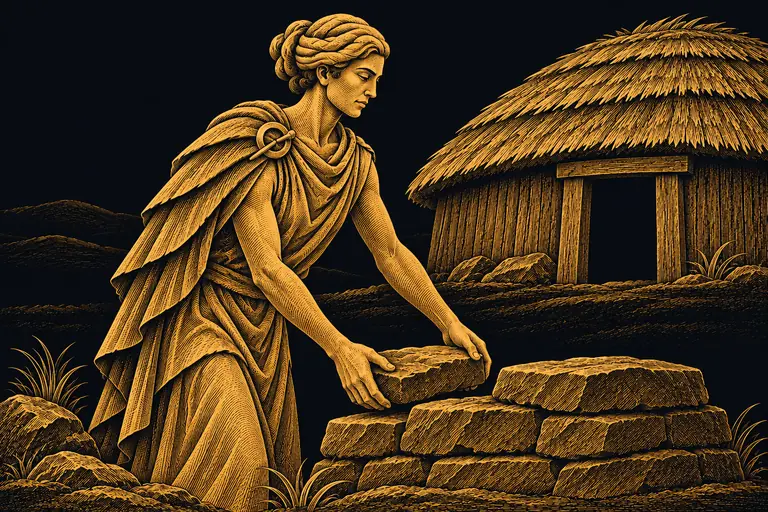
A Gilded card in this set is an engraving: the same card, cut in gold line on a near-black ground to remember a telling. The gold is the engraver's, as it is in every set, and says nothing about Ireland or the figure shown.
A Gilded card is an engraving: a plate cut in gold line on near-black by someone who wanted to remember an evening's telling. All ten sets share one engraver's hand. Few exist because a plate takes a long time to cut, not because its subject is worth more than any other.
The gold belongs to the engraver, not to the story or the culture. A Gilded card never changes the rules, and the gold adds nothing to the figure it shows.
Every card has a Base face, made in its own culture's craft: lacquer and shell for Korea, red-figure for Greece, silver and niello for Ireland, grass cord for the Andes.
Fosterling at Tara (IRL-001), Irish. Base in Insular silver with gilt bands and studs. The current review renames it Mes Buachalla, the Cowherds' Fosterling.
Signature cards
The cards that, more than any others, make this set Irish.
Tara, hill of kings, where the stone cries out under a rightful ruler.
How the set tells it
The set follows the four cycles in rough proportion to the tales that survive. About a third of its cards tell the takings and the war of the Tuatha Dé with the Fomorians, about an eighth the tales of the síd, more than a quarter the Ulster Cycle, and about an eighth each the Fenian Cycle and the kings. Its two ideas, the geis and sovereignty, run through every cycle. Bríg appears only once, as an event, keening for her son. The saints are left out, and so are leprechauns and the later folklore of the púca and the changeling.
The review mapped all 250 cards: 6 kept as they were, 103 given a truer scene, 113 given to a missing story, 28 proposed for a cut.
What the set still lacks
The Fenian Cycle is present but thin: Finn's father Cumhall, the Rowan-Tree Hostel and Finn's own death are still missing.
Emain Ablach and Mag Mell have no card of their own and are folded into the Land of Youth.
The Munster síd-queens Áine, Clíodhna and Aoibheall, and the battle of Mag Mucrama, are not yet in the set.
Several Ulster tales, among them Cú Chulainn's conception and the Intoxication of the Ulstermen, appear only inside other cards.
Earlier invasions and witnesses6
Fir Bolg and the first battle3
Arrival, Four Cities, Four Treasures10
Gods6
Lug at Tara and the muster5
Bres's reign and the first satire9
Healers and the well of Sláine7
The second battle and the Fomorians8
Craft, Bríg, the Dagda's gear, the tryst7
Lug's kin, Tuireann, Manannán5
Sons of Míl and the division of the land9
Uisnech, Tailtiu and the calendar4
Óengus, Boann and the Brug6
The Wooing of Étaín12
The Children of Lir8
The síd and Crúachan4
Emain Macha and its court9
Feasts and contests6
Cú Chulainn's youth and training8
Connla and Fand4
Deirdre and the exile of Fergus5
The Táin9
The Táin14
The Táin9
Death of Cú Chulainn6
Táin Bó Fraích1
Finn's youth and rise8
The Fianna8
Diarmuid and Gráinne5
Sadb, Oisín and the end8
Conaire and Da Derga's hostel14
Tara and the Sovereignty4
Cormac, Conn and the ruler's truth7
Other kings4
Voyages3
Poets, druids, ogham7
Later folk tradition2
Cards per canon element, from the set's review.
Sources and care
Every story here was written down by Christian scribes, centuries after Ireland became Christian, and each card carries that label. The Book of Takings is learned history on a biblical frame, not a record of real migrations, and some tales, such as Lir's children and Oisín in the Land of Youth, are later still. An outside review found that Lug, the Dagda, the Morrígan and Manannán all have devotees today, so the set's god cards are being reworked to show them only as places and events. Saints are left out. No cultural adviser has reviewed the set yet.
An independent expert review graded the proposed cards C: retain the selection, do not lock the cards. Its corrections are being worked through before the list is locked. The retellings here leave out details the review marked for checking, though some cards listed on this page still have such details open.
Lines the cards quote
Every quotation on this page and its cards comes from a public-domain translation, checked against the source text.
The doorkeeper asked of Samildánach: ‘What art dost thou practise?’…
…the sovranty of Ireland was given to that boy…
Grievous to him seemed his expulsion from his kingdom.
…so that each man of them had the spirit of a king or a mighty lord.