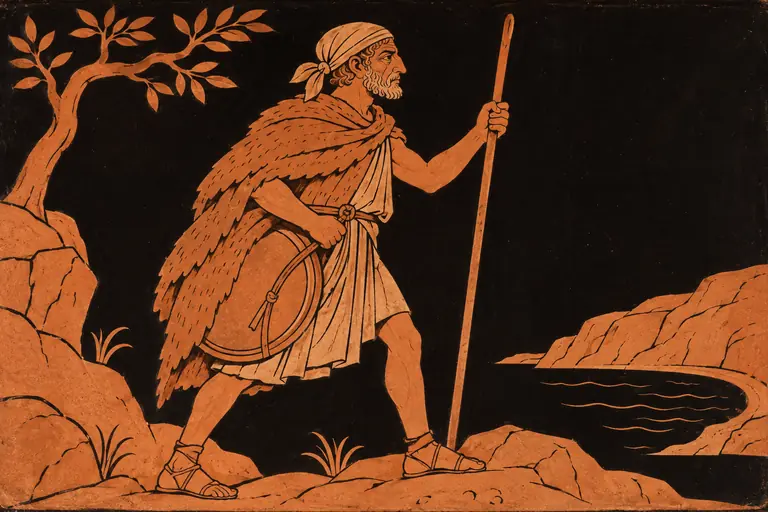
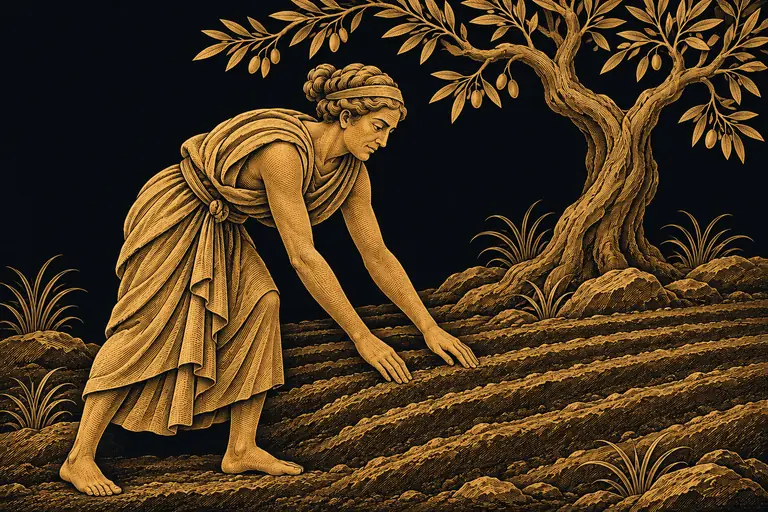
Maiden Well of Eleusis: Base art in Attic red-figure paintingDecree of Labour: Base art in Attic red-figure paintingDecree of Labour: Base art in Attic red-figure paintingMaiden Well of Eleusis: Base art in Attic red-figure paintingBase art from card GRK-003, in Attic red-figure paintingDecree of Labour: Base art in Attic red-figure paintingCrane-Dancer of Delos: Base art in Attic red-figure paintingBase art from card GRK-017, in Attic red-figure paintingBase art from card GRK-017, in Attic red-figure paintingDecree of Labour: Base art in Attic red-figure painting
Greek mythology
The task first, the price after
Greek myths are poets' stories of gods, heroes and the bargains between them; this page covers their sources, themes, nine chapters and how the MYTH set tells them.
The set
Labours and Bargains, GRK
Base craft
Attic red-figure painting
Cards
250
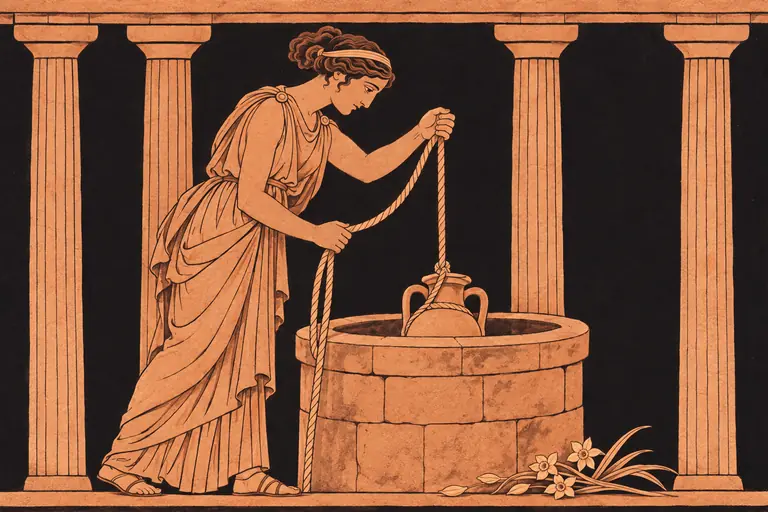
Maiden Well of Eleusis: Base art in Attic red-figure painting
The tradition
Greek mythology comes down to us through poets rather than scripture: Homer and Hesiod in the archaic age, the Homeric Hymns, the playwrights of Athens, later Greek scholars who gathered the tales into handbooks, and Roman poets such as Ovid who retold them in Latin. No single text holds all of it, and the tellings differ from city to city and poet to poet. The set names the witness behind each card, and labels Ovid as the Roman layer.
What holds the stories together is the bargain. Gods and mortals divide what is theirs, a hero does one task and then the next, and the price is named afterwards: a seed eaten in the underworld, fire paid for on a crag, a city for a promise. The gods of these stories are honoured today by followers of Hellenic religion in Greece and elsewhere, and the stories themselves are still taught, staged and retold.
Attic red-figure painting
In Athenian potters' workshops from about 530 to 320 BCE, painters left figures in the warm red of the clay and covered the ground in black gloss, drawing detail in fine black lines along a single groundline. Those painters told many of these same stories. The cards borrow the look, not the pots: an Athenian way of picturing the myths, not a record of the age they describe.
Sources
Homer, Iliad and OdysseyArchaic periodPoemsThe quarrel at Troy and Odysseus' return home, composed for performance and the spine of Greek storytelling.
Hesiod, Theogony and Works and DaysArchaic periodPoemsThe birth of the gods, the war of the Titans, Prometheus, Pandora and the jar, and the ages of mortals.
Homeric HymnsArchaic periodHymnsPoems to single gods, among them Demeter's search for Persephone and the newborn Hermes' theft of cattle.
Athenian tragedy5th century BCEPlaysAeschylus, Sophocles and Euripides, staged at Athenian festivals; the main source for Oedipus, Antigone and Heracles' death.
Apollodorus, Library1st to 2nd century CEHandbookA late Greek compiler's summary of the myths, and the fullest single account of the heroes' cycles.
Ovid, MetamorphosesEarly 1st century CEPoem in LatinA Roman poet's tales of change; the only full source for Arachne and Phaethon's ride, labelled as the Roman layer.
Themes
A price named afterwards
Greek bargains often look fair and turn out costly. At Mekone Zeus chose the portion that looked best and kept the grudge. Persephone ate a pomegranate seed below the earth and owed a third of every year for it. Paris was offered Helen in return for a judgement, and the price was a city. The stories rarely say the price at the start.
Many heroes act on a king's orders, often a king who hopes the task will be the end of them. Eurystheus sent Heracles out again and again and hid in a bronze jar sunk in the ground when the hero came back. Pelias sent Jason to Colchis for the fleece of gold, and there King Aeetes set him new tasks: yoke fire-breathing bulls with bronze feet, and sow a serpent's teeth.
Mortals who reach past their share pay for it. Phaethon took the reins of the Sun's horses and could not hold them. Icarus flew too near the sun on wings of wax. Arachne challenged a goddess at the loom. Below the earth Tantalus reaches for water that drains away, and Sisyphus pushes his stone uphill. Phaethon and Arachne come mainly from Ovid, labelled as the Roman layer.
Most of the gods in this set appear through their places, signs and deeds. Apollo is present at Delphi, which Greeks called the centre of the earth. Hermes, on the day he was born, drove Apollo's cattle backwards to hide their tracks and made peace with the lyre he had made from a tortoise shell. Hephaestus caught Ares and Aphrodite in a net of fine chains, and Athena's olive grows on the Acropolis.
Welcoming a stranger is a test in these stories, and many of them turn on it. The swineherd Eumaeus fed a beggar who was his own master in disguise. Nausicaa gave a shipwrecked man clothes and directions to her father's hall. In the last book of the Iliad, Achilles and Priam ate together as host and guest before Hector's body went home. For Odysseus, home itself is the welcome held back longest.
9 stories, in reading order, each with the cards that carry it.
From Chaos to the rule of Zeus
Cosmogony and succession · Hesiod, Theogony 116-735; Apollodorus, Library 1.1-1.2, and Homer, Iliad 15.187-193
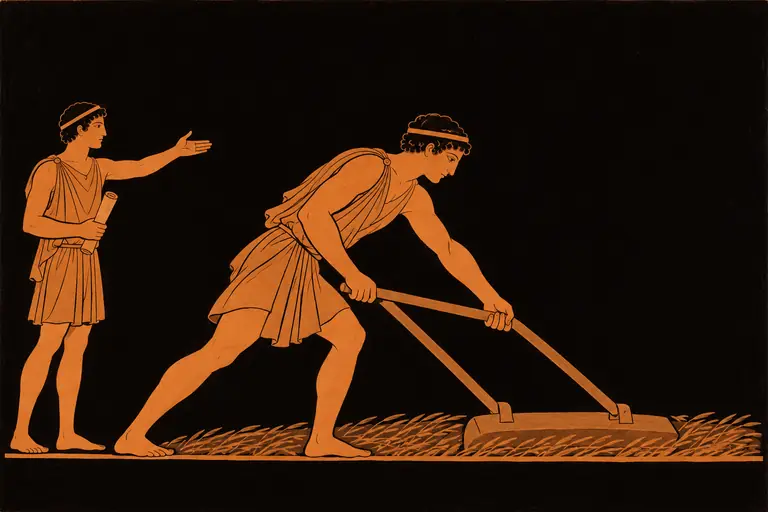
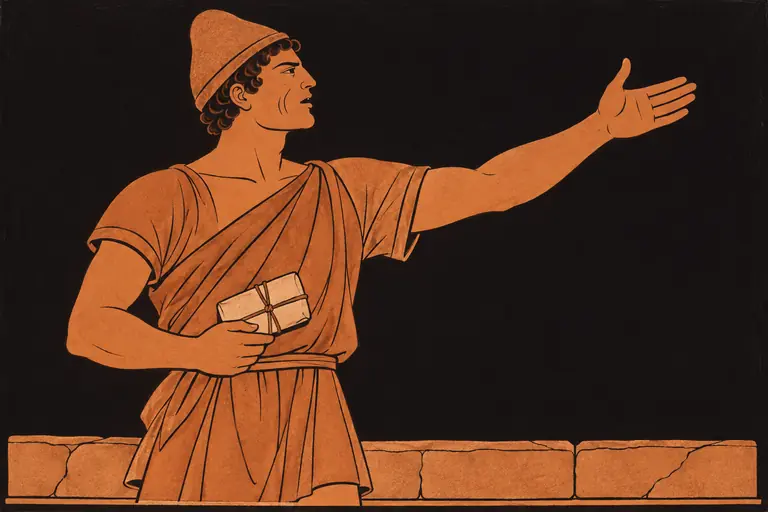
Decree of Labour: Base art in Attic red-figure painting
Hesiod begins with Chaos, a gap, and then Earth, Tartarus and Eros. Earth bore Sky, who kept their children pressed inside her, so she made a sickle of adamant and gave it to her youngest son, Cronus, who struck his father with it and parted Sky from Earth. Warned that a son of his own would overthrow him, Cronus swallowed each child his wife Rhea bore. When Zeus was born, Rhea hid him in a cave on Crete, where the Curetes clashed their shields to cover his crying, and she gave Cronus a stone wrapped in swaddling clothes instead. Grown, Zeus freed his brothers and sisters and the Cyclopes, who forged his thunderbolt. After ten years of war the Titans were shut in Tartarus, and the three brothers divided the world by lot.
The story shows power passing by force and cunning from one generation to the next, until it was shared out by lot.
Prometheus and the first mortals · Hesiod, Theogony 507-616 and Works and Days 42-105; Aeschylus, Prometheus Bound
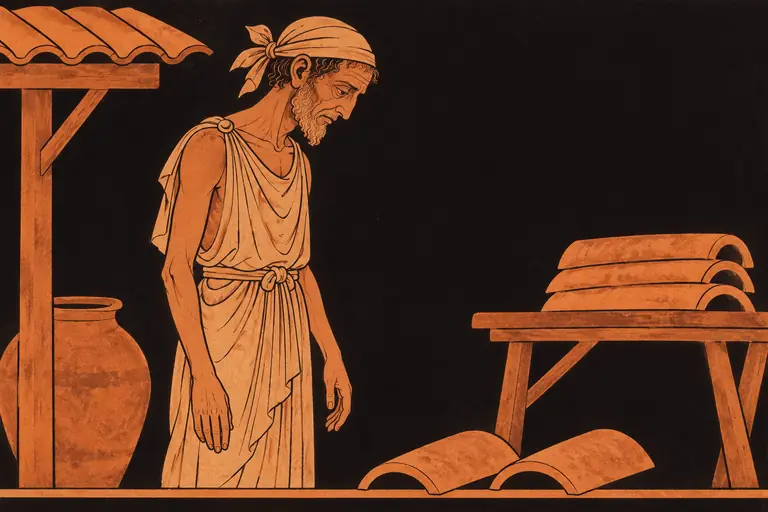
Decree of Labour: Base art in Attic red-figure painting
At Mekone, when gods and mortals were settling what each would have, Prometheus set out two portions of an ox: the good meat hidden in its stomach, and the bare bones wrapped in shining fat. Zeus chose the fat, and from then on people kept the meat and burned the bones for the gods. Zeus held back fire in return, and Prometheus stole it in a hollow fennel stalk. Zeus answered with Pandora, made by the gods at his order. Prometheus had warned his brother Epimetheus to accept nothing from Zeus, but Epimetheus took her in. She lifted the lid of a great jar, and troubles and sickness went out among people. Only Hope stayed inside, under the rim. Prometheus was bound to a crag, where an eagle came to him each day, until Heracles shot it.
The story shows a bargain fair on its face and costly in fact, and a cleverness that helped mortals and had to be paid for.
Demeter and Persephone · Homeric Hymn to Demeter (Hymn 2)
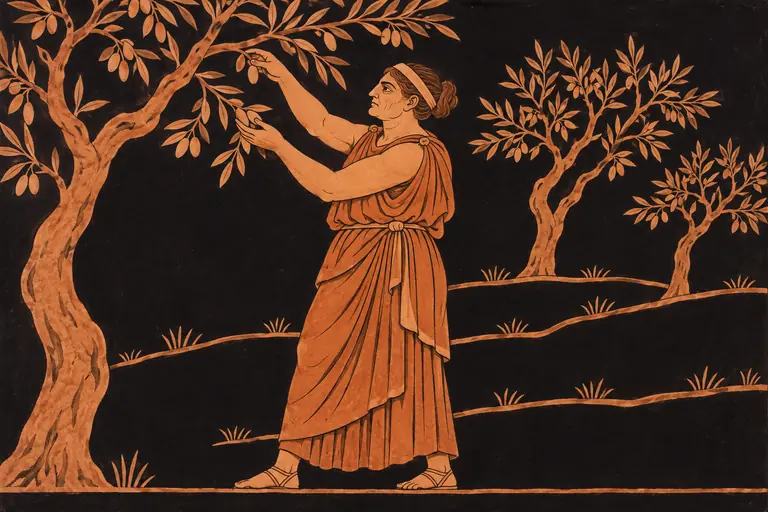
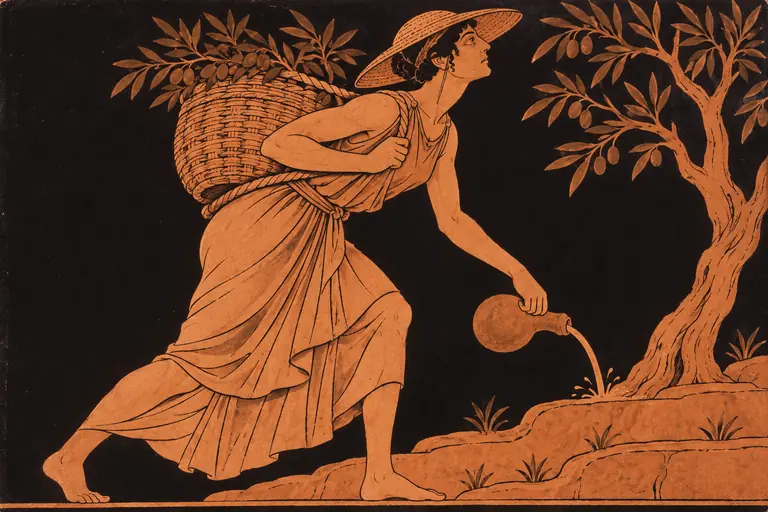
Maiden Well of Eleusis: Base art in Attic red-figure painting
Persephone was gathering flowers in a meadow when the earth opened and Hades, with Zeus's consent, carried her down to his realm. Her mother Demeter searched for nine days with torches in her hands, and learned the truth from the Sun. Grieving, she came to Eleusis in the shape of an old woman and sat by the Maiden Well, where the king's daughters found her. In their house Iambe's jokes made her smile, and she nursed the baby Demophon, laying him in the fire at night to make him deathless, until his mother saw and cried out. Then Demeter kept the grain in the ground. Famine threatened mortals and the gods' honours alike, so Zeus sent Hermes to bring Persephone back. But she had eaten a pomegranate seed below, and so spent a third of every year there.
The story holds up a mother's refusal that made even the gods bargain, and a return that was real but never complete.
And the child grew like some immortal being, not fed with food nor nourished at the breast…
…at night she would hide him like a brand in the heart of the fire…
…the Maiden Well, from which the women of the place were used to draw water…
Heracles · Apollodorus, Library 2.4.8-2.7.7; Pindar, Nemean 1, and Sophocles, Women of Trachis
Base art from card GRK-003, in Attic red-figure painting
Heracles was the son of Zeus and the mortal Alcmene, and Hera hated him from birth. While he was still in his cradle he strangled two serpents sent against him. As a grown man he was told by the oracle at Delphi to serve his cousin Eurystheus, who ruled Mycenae, and to carry out the tasks he set. Eurystheus set ten, then refused to count two of them, so there were twelve in the end. Heracles killed the lion of Nemea and wore its skin, fought the Hydra with his nephew Iolaus, held up the sky while Atlas fetched the golden apples, and brought Cerberus up from the house of Hades. Years later his wife Deianeira, misled by the centaur Nessus, sent him a robe that burned him, and he had himself laid on a pyre on Mount Oeta.
The story shows strength put under orders: a hero who finished every task he was given and was undone by a gift.
First, Eurystheus ordered him to bring the skin of the Nemean lion…
Perseus and Bellerophon · Apollodorus, Library 2.4.1-2.4.3; Hesiod, Theogony 270-283, and Pindar, Pythian 12
Decree of Labour: Base art in Attic red-figure painting
Acrisius of Argos was told that his daughter's son would kill him, so he shut his daughter Danae away. Zeus reached her all the same, and when she bore Perseus, Acrisius set mother and child adrift in a chest. It came ashore on Seriphos. Grown, Perseus was sent to fetch the head of Medusa, the one Gorgon of three who could die. He took the single eye the Graeae shared and kept it until they told him the way. Nymphs gave him sandals with wings, a cap that hid its wearer and a bag. Looking only at her reflection in his bronze shield, he cut off Medusa's head while she slept. Her two sisters woke and chased him, but could not see him. On the way home he freed Andromeda, chained to a rock by the sea.
The story shows a task meant to be impossible done with borrowed things, by a hero who won by not looking straight at what he faced.
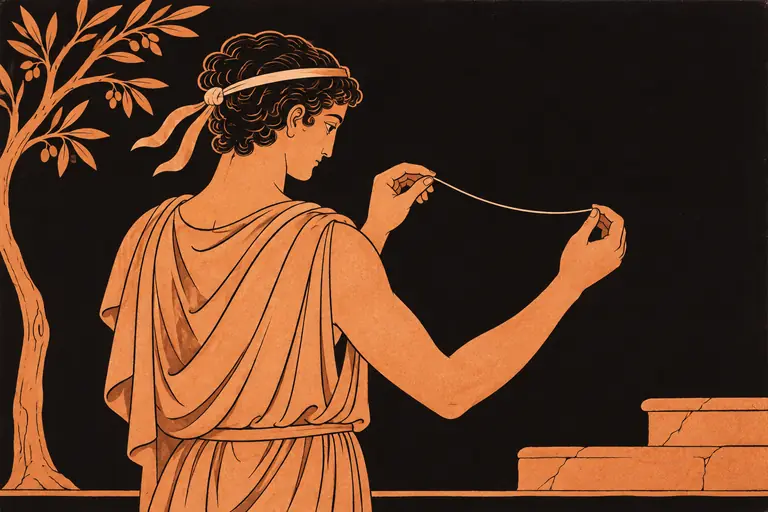
Crane-Dancer of Delos: Base art in Attic red-figure painting
Every nine years Athens sent young men and women to King Minos of Crete, for the Minotaur, the bull-headed son of his queen, kept in the Labyrinth that Daedalus had built. Theseus, son of King Aegeus, sailed with them. Minos's daughter Ariadne gave him a thread to unwind as he went in. He killed the Minotaur, followed the thread back out, and Ariadne left Crete with him. On the island of Naxos he left her, and in some tellings Dionysus found her there. At Delos the young Athenians danced a winding dance that followed the turns of the maze. Aegeus had asked his son to raise a white sail if he came home alive. Theseus forgot, and the old king, seeing the sail still black, died in his grief.
The story shows a victory won with someone else's help, and a homecoming spoiled by one forgotten promise.
…an imitation of the circling passages in the Labyrinth…
Thebes · Apollodorus, Library 3.4-3.7; Sophocles, Oedipus the King and Antigone, and Homer, Odyssey 11.271-280
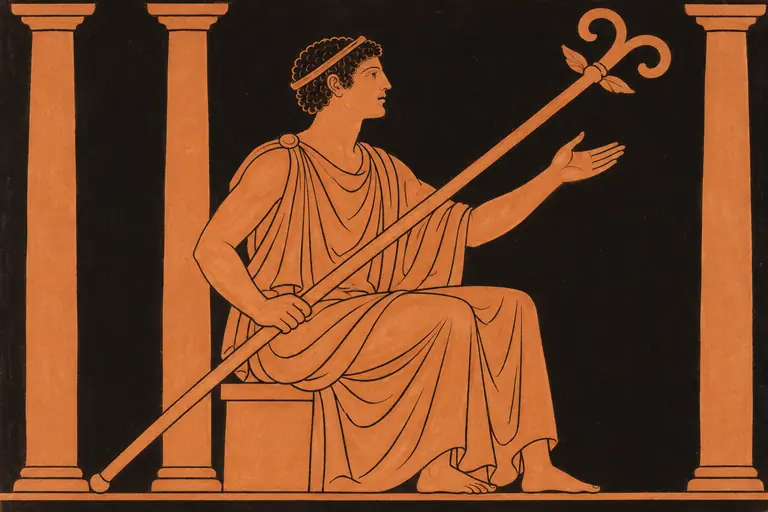
Base art from card GRK-017, in Attic red-figure painting
Cadmus, sent from Phoenicia to find his sister Europa, followed a cow to the place where Thebes would stand. He killed the serpent that guarded a spring there and sowed its teeth, and armed men rose from the ground and fought until five were left. They became the city's first families. Generations later Laius, warned that his son would kill him, had the baby Oedipus left on a mountain. Oedipus lived, killed Laius at a crossroads without knowing who he was, answered the Sphinx's riddle and married the widowed queen, his mother. When plague came, the seer Teiresias and his own questions brought the truth out. His sons later died fighting each other at the gates, and Antigone buried her brother Polynices against King Creon's order.
The story asks how much a person can know about their own life, and what a sister owed her brother against the city's law.
…he sent his commands for the labours through a herald, Copreus…
The Trojan War · Homer, Iliad 1, 16, 22 and 24, and Odyssey 4 and 8; the Cypria, in Proclus' summary
Base art from card GRK-017, in Attic red-figure painting
When Peleus married Thetis, Strife came to the feast and set Hera, Athena and Aphrodite quarrelling over which was the most beautiful. Paris, a prince of Troy, was made judge and chose Aphrodite, who promised him Helen, wife of Menelaus of Sparta. Paris left Sparta with Helen, and the Greek kings sailed for Troy under Agamemnon. The Iliad tells a few weeks of the tenth year. Agamemnon took Briseis from Achilles, and Achilles withdrew from the fighting. His friend Patroclus went out in his armour and was killed by Hector. Achilles returned, killed Hector and kept his body, until old Priam came by night to his tent, kissed his hands and asked for his son. Achilles gave the body back. The Odyssey tells how the city fell at last, to a wooden horse filled with men.
The story holds up a night when two enemies wept together over their dead, in the middle of a war neither could stop.
The Odyssey · Homer, Odyssey 6, 9, 11, 12, 17, 21 and 23
Decree of Labour: Base art in Attic red-figure painting
After Troy, Odysseus of Ithaca took ten years to reach home. He told the Phaeacians how he had blinded the Cyclops Polyphemus after giving his name as Nobody, how he had sailed to the edge of the world to question the dead, and how he had been tied to the mast so that he could hear the Sirens and live. Shipwrecked and alone, he was found on a shore by Nausicaa, who showed him the way to her father's hall. On Ithaca he came home disguised as a beggar. His old dog Argos knew him, and died. He strung the great bow that none of the suitors could bend. Penelope tested him last, with the bed he had built round the trunk of a living olive tree, which no one could move.
The story values cunning, patience and a guest's welcome, and makes home something proved by what only two people know.
Gilded cards in this set are engravings: each is cut again in fine gold line on near-black, a new composition of the same telling, made to remember it. The gold is the house engraver's, the same in all ten sets, and belongs to no tradition.
A Gilded card is an engraving: a plate cut in gold line on near-black by someone who wanted to remember an evening's telling. All ten sets share one engraver's hand. Few exist because a plate takes a long time to cut, not because its subject is worth more than any other.
The gold belongs to the engraver, not to the story or the culture. A Gilded card never changes the rules, and the gold adds nothing to the figure it shows.
Every card has a Base face, made in its own culture's craft: lacquer and shell for Korea, red-figure for Greece, silver and niello for Ireland, grass cord for the Andes.
Tiryns Levy (GRK-001), Greek. Base in Attic red-figure painting. The current review renames it Myrmidon of Phthia.
Signature cards
The cards that, more than any others, make this set Greek.
Oedipus, who answered the Sphinx and then had to learn who he was.
How the set tells it
The set tells a dozen cycles: the succession of the gods, Prometheus and the jar, Demeter and Persephone, Heracles, Perseus and Bellerophon, Theseus, Jason, Thebes, the house of Atreus, Troy and the Odyssey, with a small group of Ovid's tales. Homer is its spine, and Demeter's story is the most fully told. Zeus, Demeter, Poseidon, Hermes and Athena stand as great figures of their own stories. Every other Olympian appears only as places, events and things, never as a playing piece. Stories whose victims are children, such as the madness of Heracles, are left out on purpose.
The review mapped all 250 cards: 96 kept as they were, 14 given a truer scene, 130 given to a missing story, 10 proposed for a cut.
What the set still lacks
The madness of Heracles is left out on purpose, because its victims are his children.
Iphigenia at Aulis appears only as an omen, and Hippolytus and Phaedra have no card.
Theseus' road to Athens and Sarpedon carried home by Sleep and Death have no card yet.
Electra, and gods' own tales such as Callisto, Semele and Adonis, are still missing.
Cosmogony, succession, Prometheus, the Ages and the Flood35
The Olympians and their myths41
Demeter and Persephone13
The underworld and Orpheus10
Heracles29
Perseus and Bellerophon10
Theseus, Crete and Daedalus12
The Argo and the Calydonian hunt14
Thebes10
Troy31
The Odyssey28
The house of Atreus7
Tales of overreach and change10
Cards per canon element, from the set's review.
Sources and care
The Greek gods are worshipped today: Hellenic religious groups in Greece and elsewhere hold rites for Zeus, Athena, Demeter and others. In this set the Olympians appear only as places, events and things, never as playing pieces, except five: Zeus, Demeter, Poseidon, Hermes and Athena stand as great figures of their own stories, who come into the telling and withdraw. An outside reader has asked that these five become events too, and that hero figures such as Heracles and Prometheus be checked the same way. Review by outside advisers is still owed. The sources are poems and plays from many centuries and cities, not one scripture, and Ovid's Latin versions are a Roman layer, labelled on every card that uses them.
An independent expert review graded the proposed cards B: revise before adoption. Its corrections are being worked through before the list is locked. The retellings here leave out details the review marked for checking, though some cards listed on this page still have such details open.